
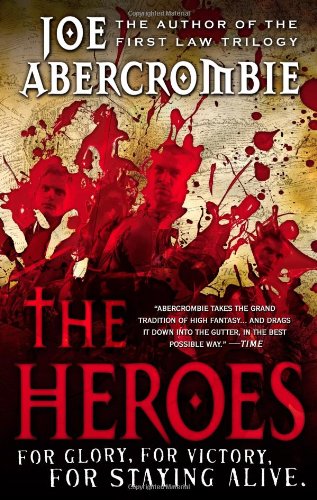
 The Heroes by Joe Abercrombie
The Heroes is another story set in the same world as Abercrombie’s First Law trilogy. Veteran readers will be happy to be reacquainted with several characters from earlier books: the wizard Bayaz; the dishonored warrior Bremer dan Gorst; Finree dan Brock, Union Commander Marshal Kroy’s ambitious daughter; Black Dow, the ruthless leader of the Northmen. But if you haven’t read any of Abercrombie’s books yet, don’t worry — you don’t need to have read them in order to fully enjoy The Heroes.
If you have read the earlier books, you’ll recall that a conflict, provoked by the manipulations of two rival magical forces, has been brewing between the Union and the barbaric Northmen who are probably best compared to the historical Vikings. When The Heroes opens, the Union is staging forces to fight. At this point, after much provocation by both sides, the Union is marching as the aggressors and the Northmen are on the defense.
The conditions that the combatants live in vary greatly depending on which side they are on and their station in life. Abercrombie paints a realistically harsh picture of both sides of the battlefield. It’s gritty, dark and, as a soldier, I can say that it’s an excellent depiction of what combat and the movement and life of a soldier would be like in these conditions. For the Northmen it’s rough living, carrying things on their back and living off what they can hunt up or scavenge. The Union is better provisioned, but the Nobility and Officers live in much superior conditions than their conscripted troops.
On both sides of the battle we follow a number of different characters who, in their own way, make mistakes and act honorably or dishonorably. But even when we see heroic or altruistic acts performed, Abercrombie shows us the counterpoint to those actions, the second and sometimes third order motivations that prompt them. So, the awe-inspiring swordsman, the all-powerful wizard, the conniving military wife, the slacker, the grumpy old soldier, the vicious Leader, the devious young man, and the untried new warrior all teach us about honor and courage…. or the lack thereof. Their stories don’t follow the straightforward and expected course; instead, these characters are led through trials and tests that they handle in very different ways and the resulting twisted paths are captivating to follow.
The other thing that is really amazing about Abercrombie’s storytelling is how realistic the combat can be. Things like the strategy of staying on a line with your fellow soldiers makes so much sense when you see how an uneven line can be exploited. His depiction of the rigorous training that the Champion of the Union forces puts himself through translates brilliantly into actual combat prowess. These are the sort of logical underpinnings that take a good story and make it into something truly profound. The why that explains a hero’s greatness is so often overlooked.
The Heroes is brilliant storytelling. The cover reads, “Three men, One Battle, No Heroes” and that is a perfect description. Joe Abercrombie’s latest book should be at the top of your list and even if you have not yet read the previous novels that are set in this world, you should still read The Heroes. Gritty, harsh, powerful storytelling that takes you into the crucible of combat and lets you see how the perception of the hero is not always thereality of the hero.
~John Hulet
 I often struggle when someone asks me what my favorite fantasy book is. I’ve read so many great books that it’s very difficult to pick one above all the others. I don’t have that problem anymore. My answer now is easily Joe Abercrombie’s The Heroes. I cannot think of another book I have enjoyed so much on so many levels. That’s a bold statement, you say? Yes it is. This book deserves it, and I will do my best to try and explain why.
The overall plot of The Heroes is relatively simple. It follows a battle over the course of three days. The battle is being fought between “The Union” and “The North.” The Union is an entity that has much in common with medieval England. The North has much in common with Vikings or some other barbarian state. They’ve been brought together in war through a series of convoluted events that happened in previous novels. The reasons they are fighting are completely unimportant. The focus of this story is the individuals doing the fighting, not the fight itself. They all have their own reasons for being there.
If you are familiar with Abercrombie’s work then it will come as no surprise to you that there are no “Heroes” in this story. These are flawed human beings, and over the course of three days you follow several of them through their various trials and tribulations. Abercrombie paints the most realistic characters you can imagine. He’s so good at writing these colorful and disturbed individuals. Abercrombie will have you siding with mass murderers and feeling sorry for psychopathic killers, and you won’t even notice.
As with Abercrombie’s other works, this book is violent, vulgar, and often absolutely hilarious. Abercrombie is a master of dark humor and uses profanity with an artist’s touch. The profane inner monologue of Col. Bremmer Dan Gorst nearly had me weaving into oncoming traffic with laughter while listening on audio. Entire complex and awful situations are often summarized by characters in a single expletive. I absolutely loved it.
 The writing is superb. Abercrombie has honed his style to a razor’s edge. He continues to improve upon excellence. I thought Best Served Cold was nearly flawless, but I would have to say The Heroes is one step closer to perfection in my opinion. If he continues this trend I will have no choice but to sell my worldly possessions and start a cult in his name.
I listened to The Heroes on MP3 by Tantor Audio, narrated by Michael Page. Mr. Page does an excellent job with the voice characterizations. The North men tend to sound similar, but there are only so many “gravel rough” voices a guy can do. The voice acting was just enough to draw you into the story without being overdramatic. I was very pleased with the overall production and would not hesitate to listen to more from Tantor or Michael Page.
~Justin Blazier
The war between the Union and the North culminates in a three-day battle among two small villages, bogs, and barley fields. The high ground is a saddled hilltop ringed by ancient standing stones called the Heroes. The ruthless fighting prowess of Black Dow, the new king of the North, is pitted against Lord Marshal Kroy, the commander of the southern King’s army. The Heroes reads more like historical fiction than fantasy. In true Joe Abercrombie fashion, it’s a grim tale told by an array of intensely colorful and intriguing characters.
Joe Abercrombie is to fantasy books what Clint Eastwood was to Western movies; he’s taken the genre to a whole new level of badass.
From beginning to end, reading about medieval warfare cannot get any more real than it is in The Heroes. This book is sure to give readers the instinctive urge to duck a swinging battle-axe or dodge a spear thrust. As always, Abercrombie is a master of dialogue that ranges from hysterical to profound. While reading The Heroes, the pages (the e-pages, in my case) disappeared and I achieved the Holy Grail of bookworms: the complete mental transportation from reality into the imaginary world. If action is not your thing, worry not.
This is a war story that takes place in the same world as Joe Abercrombie’s other books: The First Law Trilogy and Best Served Cold. Take a gander at the “Order of Battle” — the character list, which is cleverly placed at the beginning of the book instead of the end. Bayaz, Bremer dan Gorst, Black Dow, and The Dogman return from The First Law Trilogy. We also see some of Curnden Craw’s “dozen.” Named Men like the woman warrior called Wonderful and Whirrun of Bligh introduced in “The Fool Job,” Abercrombie’s short in Swords and Dark Magic, are more than enough for established Abercrombie fans. For newcomers, how could you not be enticed by names like Rurgen and Younger (who are described as “faithful servants, one old … one younger”), Corporal Tunny, Caul Shivers, Pale-as-Snow, and Stranger-Come-Knocking? (Notice anything, veteran fantasy readers? Those names are all easily pronounced, making the story flow much better than many other fantasy stories where the author insists on bogging the reader down with words almost humanly impossible to utter.)
As in Abercrombie’s other books, the reader is often drawn to the most despicable of scoundrels like “Prince” Calder, whose clever wit gets him both into and out of trouble, or the standard-bearer Corporal Tunny, a con-artist who is proud that, despite his long-service, he’s managed to rise no further in rank. There is also the politically ambitious Finree dan Brock. In a male dominated society, she strategically designs her husband’s rise to power despite his own lack of ambition. My favorites are always Abercrombie’s warrior-heroes, like Whirrun of Bligh, a.k.a. Cracknut. Each time Whirrun carries the Father of Swords into battle he wears fewer clothes. Col. Gorst is a master swordsman plagued with a high feminine voice. Gorst is angry at everyone, including himself most of all, and can only find joy in mortal combat. Those are only a handful of sensational but believable characters that bring this gritty story to life.
Joe Abercrombie’s writing is both fresh and edgy. He has that deep understanding of the human psyche and society that only the very best writers possess. The only other fantasy author that so grandly wrote such gray tales was the late master, David Gemmell.
I had such a good time reading Abercrombie’s latest story that I didn’t want it to end. If I read just one more new fantasy book in 2011 that’s two-thirds as good as The Heroes, I will consider it an outstanding year for the genre.
~Greg Hersom
 Joe Abercrombie’s The Heroes is not named for its characters. Instead, “The Heroes” are a circle of stones at the top of a hill. Warriors were presumably buried beneath these stones long ago, and there will certainly be a high number of bodies to bury by the novel’s conclusion.
Yes, The Heroes is a fantasy novel about the soldiers caught in the middle of a war between the armies of the North and the armies of the Union. Readers are treated to scheming politics, petulant and pompous generals, and hard-working soldiers struggling to survive the next battle. There is no overarching purpose or justification to the war or to either side beyond power, so don’t look for good or evil. Look for gore.
The Heroes is a hard-boiled fantasy that fans of Glen Cook’s THE BLACK COMPANY or Steven Erikson’s MALAZAN books will enjoy. In other words, this is definitely not a traditionally romantic fantasy. Instead, The Heroes is a song to accompany drinking and marching rather than swooning and daydreaming. There are no spiritual martial artists who gracefully cut through violent hordes of opposition; there are just hordes of violent opposition.
There is also a strong awareness of fantasy’s conventions. Abercrombie clearly wants to create memorable soldiers — traditional fantasy’s “badasses,” if you will — but he is reluctant to characterize them in conventional ways. For example, Robert Jordan’s Rand al’Thor is capable of silencing a room full of generals with a glance. Pretty impressive, but a little cliché for today’s reader of swords and sorcery. Joe Abercrombie’s Lord Bayaz, we are assured, gives “no immediate impression of supreme power.” However, within a few paragraphs readers realize he is a “badass” because he has silenced a room full of generals.
At times, this self-awareness is refreshing, and it usually leads to a bit of fun at the expense of Abercrombie’s characters. When Stranger Comes Knocking, a giant warrior fighting with the North, at one point reveals his frame, it is described as a “great expanse of body, sinew-knotted like an ancient tree … almost more scar than skin. He was ripped, pocked, gouged with wounds, enough to make a score of champions proud.” It’s hard to imagine Abercrombie describing any of his characters without grinning. And in this way the novel occasionally takes on the gallows humor that one might expect from a group of soldiers. When a group of young recruits join the Union cavalry, one trooper asks why there are no horses, to which the corporal responds:
That’s an excellent question and a keen grasp of tactics. Due to an administrative error, our horses are currently with the Fifth, attached to Mitterick’s division, which, as a regiment of infantry, is not in a position to make best use of them. I’m told they’ll be catching up with us any day, though they’ve been telling me that a while. For the time being we are a regiment of… horseless horse.
I can’t help wondering if this isn’t the reality of army life.
There is little room in Abercrombie’s world for fantasy’s traditional hero: naturally talented, humbly courageous, with a somber sense of responsibility. Surprisingly, this world does not glorify its sadistic warriors. It celebrates grit, particularly the grit of men and women that make the best of bad situations.
Much of The Heroes is self-aware of fantasy’s conventions and can be enjoyed as a pastiche. However, it is first and foremost a novel about (mostly) men fighting with swords in the rain and mud. The majority of the novel’s structure is present to introduce readers to the soldiers and armies of the Union and the North before maneuvering everyone into position around a single hill — the Heroes. A bell doesn’t ring, but eventually the battle starts and fans are treated to an MMORPG raid of epic proportions.
Others wondering whether or not The Heroes is for them would do well to ask themselves whether they are like Calder, one of Abercrombie’s northern generals. At one point, Calder reflects that he feels “a little fear and a lot of contempt at the level of manliness on display.” Readers that expect more than a stiff-upper lip from their heroes should probably read something else. For readers that revel in gritty swordplay, The Heroes is a must read.
~Ryan Skardal


It’s always great to discover a book that you know is an all-time favorite (or THE all-time favorite). Great review.
This is not my kind of book at all, but what a nice review! I agree, it’s nice to feel that little “snap” when you know you’ve found a favorite.
Justin- I couldn’t agree more, I ate this book-up. I didn’t want it to end.
Ryan- You’re review was spot-on. Well done. I’m just curious about the 3 star rating though. I take that you’re not in the camp of reveling in gritty swordplay? :)
Nothing wrong with that if you’re not. Abercrombie is one of my favorite authors, but I cannot say enough that he appeals mostly to somewhat twisted taste in story telling. In fact, for me, that’s part of why I like him so much.
“I take that you’re not in the camp of reveling in gritty swordplay?”
Everything has its limit, unfortunately.
I agree with Ryan. I haven’t even read The Heroes yet, though I have it in audio. The afterglow of Best Served Cold is still with me, so I’m not ready to face any more of Abercrombie’s “heroes” for a while.
Kat- Actually I think you may be surprised with The Heroes. Its not as “icky” as Best Served Cold. To me The Heroes is kinda like a darker David Gemmell on steroids. No real good guys or bad, its just a matter of perspective.
For some reason, I see you liking “Prince” Caulder. He’s a very resourceful scoundrel, that has charisma despite being coward most times. (actually, calling him a coward is harsh, he just appreciates living more than the other Northmen.)
“icky” — I can tell you’ve read my reviews, Greg! ;)
I will try The Heroes. Thanks for the suggestion!
I can’t wait to see it, Kat. I always love seeing your perspective in particular for my favorite books. Especially, when it seems like something that guys would like better. :)
Very good read. Almost more alternate history than fantasy.