Next Author: Sylvia Kelso
Previous Author: Marjorie B. Kellogg

Are we missing a book that should be on this page? Please submit.

James Patrick Kelly

James Patrick Kelly(1951- )
James Kelly grew up in Mineola, New York. He began publishing in the 1970s. Kelly attended Notre Dame University and graduated cum laude. He has won two Hugos, one in 1996 for “Think Like a Dinosaur” and one in 2000 for “1016 to 1”, and a Nebula in 2007 for his novella “Burn.” He is an alumnus of the Clarion fiction workshops. Currently he teaches at the University of Southern Maine. Learn more at James Patrick Kelly’s website.

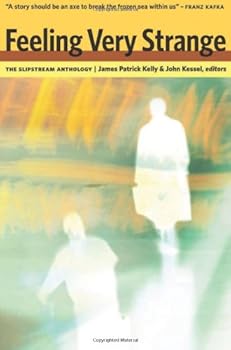
Feeling Very Strange: The Slipstream Anthology

Feeling Very Strange: The Slipstream Anthology  edited by James Patrick Kelly & John Kessel

Is there really any difference between post-modernism, interstitial fiction, slipstream and New Weird? Does anyone know? James Patrick Kelly and John Kessel try to outline the boundaries of slipstream with their anthology, Feeling Very Strange: The Slipstream Anthology, particularly by including a learned introduction and excerpts from a discussion that took place on the subject on a blog a few years ago. Ultimately, like so many things literary, from science fiction to erotica, it comes down to this: slipstream is what I’m pointing to when I say “slipstream.” Yes, there are a few defining features. It’s fantas... Read More

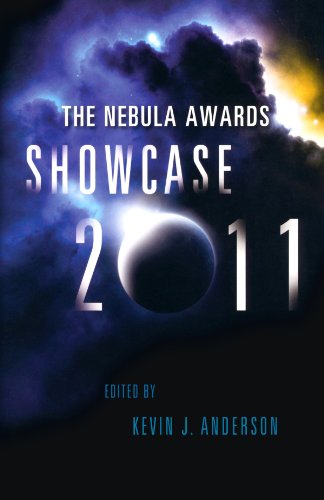
The Nebula Awards Showcase 2011: Sample the best SFF

The Nebula Awards Showcase 2011 edited by Kevin J. Anderson

The Nebula Awards are one of the great institutions in science fiction and fantasy. Each year since 1965, the members of the Science Fiction and Fantasy Writers of America (SFWA) have voted for the Best Novel, Novella (40,000-17,500 words), Novelette (17,500-7,500 words), and Short Story (less than 7,500 words) in SF and fantasy. Compiling a list of the nominees and winners for all those years would get you an excellent reading list and a comprehensive cross-view of the best that can be found in the genres. To make this task easier, every Nebu... Read More

By Jonathan Lethem, John Kessel and James Patrick Kelly

Ninety Percent of Everything — (2001) Publisher: From the collaborative team of Jonathan Lethem, John Kessel and James Patrick Kelly come two short novels of the near but-very-odd future. In “Ninety Percent of Everything” mysterious aliens have landed but nobody can figure out what they want. Enter Liz Cobble, a frustrated professor of sapientology who finds herself swept up in a madcap romantic adventure with an eccentric billionaire and an architect who designs flying buildings. In “The True History of the End of the World,” Chester Drummond, would–be revolutionary and one time presidential candidate, loses his way when his world is transformed into a utopia. The Carcopino-Koster boost has made almost everyone kinder, gentler — and smarter. What’s a politician to do? Lethem, Kessel and Kelly, all established, award-winning writers with their own unique voices, harmonize here in two compelling stories reprinted for the first time.


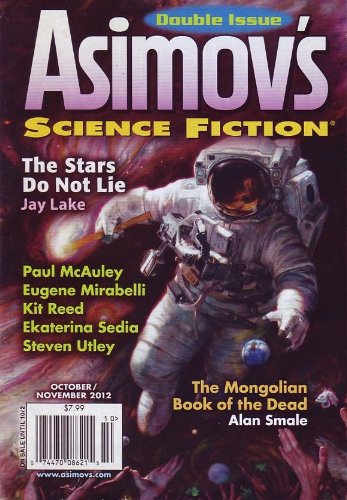
Magazine Monday: Asimov’s, October/November 2012

Sheila Williams, the editor of Asimov’s, says that the annual October/November issue is “slightly spooky.” There are a few frights in the magazine, as well as some solid science fiction, but overall, I was generally disappointed in this double issue.

Alan Smale’s novella, “The Mongolian Book of the Dead,” was not one of the disappointments; to the contrary, it is a nicely imagined tale of what might happen if the Chinese decide to mount a military invasion of Mongolia — an independent landlocked country sandwiched between Russia and China. I enjoyed Smale’s use of folklore, fantasy and politics as seen through the eyes of an American caught in the wrong place at the wrong time, a man who serves as a linchpin for the plans of an ugdan, the female equivalent of a shaman. The shadow of Chinggis Khan and his fearsome band of Mon... Read More

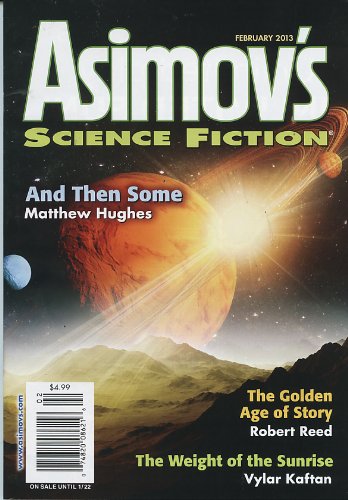
Magazine Monday: Asimov’s, February 2013

The February 2013 issue of Asimov’s is a delight from cover to cover. This time around, it’s the longer pieces that really given it is heft.

“The Weight of the Sunrise” by Vylar Kaftan is a fascinating alternate history novella that offers a pointed perspective on American history, serving as a sort of bookend to the recent film, “Lincoln.” Slavery was an evil obvious even to those who practiced human sacrifice and saw nothing wrong with incestuous marriages of royalty, as did the Incas, as Kaftan makes clear. Kaftan envisions an Incan civilization that has escaped the ravages of Spanish conquistadors with military cunning. Smallpox still troubles the Incas, though they have learned in this tale, unlike in life, to manage it through quarantine, thanks to the insight of a great physician. This makes it a strong and wealthy civilization in the 18th century when the Americans are planning for revolution. The Americans send an ambassador to t... Read More

Magazine Monday: Asimov’s, April/May 2013

The April/May 2013 issue of Asimov’s leads off with a difficult but exciting novella by Neal Asher entitled “The Other Gun.” It portrays a complicated universe in which humanity has found itself at war with a race called the prador, which is ruthless, merciless and completely uninterested in compromise. It has already exterminated several species when it runs into humans, and a survivor of one of those wars, a member of a hive species, has allied itself with humans. The narrator of this tale is a parasitologist and bio-synthesist who was working on a biological weapon to be used against the prador when he was reassigned to work for the Client, as he knows the survivor of another species. The Client has somehow managed to steal a prador cargo ship, and is using it to hunt down pieces of a doomsday weapon called a farcaster that had been broken up and scattered across the galaxy. The narrator no longer has a human body in any sense that we... Read More

Magazine Monday: Galaxy’s Edge Magazine, Inaugural Issue

Galaxy’s Edge Magazine is a new bimonthly publication appearing in both paper and electronic forms. The March 2013 issue is the first, and I purchased a copy of the electronic version as soon as it came to my attention. However, compared to Asimov’s, Clarkesworld, and F&SF Read More

Array ( [SERVER_SOFTWARE] => Apache [REQUEST_URI] => /fantasy-author/kellyjamespatrick/ [DOCUMENT_ROOT] => /home3/fantatn0/public_html [GATEWAY_INTERFACE] => CGI/1.1 [HTTP_ACCEPT] => text/html,application/xhtml+xml,application/xml;q=0.9,*/*;q=0.8 [HTTP_ACCEPT_ENCODING] => gzip [HTTP_ACCEPT_LANGUAGE] => en-us,en-gb,en;q=0.7,*;q=0.3 [HTTP_CF_CIP_TAG] => 0 [HTTP_CF_CONNECTING_IP] => 54.224.79.93 [HTTP_CF_IPCOUNTRY] => US [HTTP_CF_RAY] => 7330650575802b9 [HTTP_CF_VISITOR] => {\"scheme\":\"http\"} [HTTP_CF_WAN_ENCODING] => 0 [HTTP_CF_WAN_ID] => 0 [HTTP_CONNECTION] => Keep-Alive [HTTP_HOST] => www.fantasyliterature.com [HTTP_USER_AGENT] => CCBot/2.0 [HTTP_X_FORWARDED_FOR] => 54.224.79.93 [HTTP_X_FORWARDED_PROTO] => http [PATH] => /bin:/usr/bin [QUERY_STRING] => [REDIRECT_STATUS] => 200 [REDIRECT_URL] => /fantasy-author/kellyjamespatrick/ [REDIRECT_W3TC_ENC] => _gzip [REDIRECT_file_gzip] => /ramdisk/cpud/status [REMOTE_ADDR] => 54.224.79.93 [REMOTE_PORT] => 17776 [REQUEST_METHOD] => GET [SCRIPT_FILENAME] => /home3/fantatn0/public_html/index.php [SCRIPT_NAME] => /index.php [SERVER_ADDR] => 69.195.124.64 [SERVER_ADMIN] => [email protected] [SERVER_NAME] => www.fantasyliterature.com [SERVER_PORT] => 80 [SERVER_PROTOCOL] => HTTP/1.1 [SERVER_SIGNATURE] =>
Apache Server at www.fantasyliterature.com Port 80
[file_gzip] => /ramdisk/cpud/status [PHP_SELF] => /index.php [REQUEST_TIME] => 1369325515 [argv] => Array ( ) [argc] => 0 )