A Wizard of Earthsea by Ursula Le Guin
I love the way that Ursula Le Guin writes. Her prose is both lyrical and powerful. She makes every word count -- each is necessary, there’s no fluff or redundancy — it's simple, natural, alive, and vivid.
Le Guin's understanding of different peoples and cultures (her father was an anthropologist and her mother was a psychologist) enhances her ability to create imaginative, creative, and believable characters and worlds. When you step into Earthsea, you feel like you're in a real world with real people. It's deep and engrossing right from the start.
I also like Le Guin's of magic system here: knowing the "true" name of something gives you power over it. You just have to find its true name.
This is the original boy-finds-out-he’s-a-wizard-and-goes-to-wizard-school novel and it's suitable for adults and kids. I should mention, though, that it... Read More
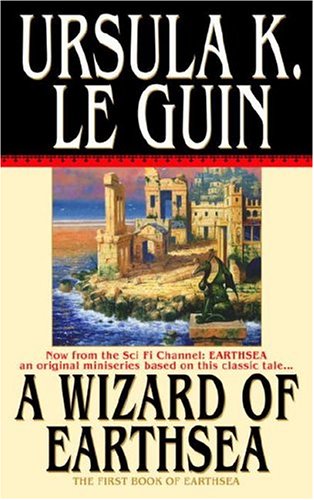
A Wizard of Earthsea by Ursula Le Guin
With the recent Sci- Fi Channel miniseries, there is bound to be renewed interest in Ursula Le Guin's classic first book in her Earthsea series, as there should be. This remains a classic fantasy for good reason. The world within which the characters move is fully developed, having a sense of past, present and future as well as a sense of a larger "there there", as opposed to some fantasies that feel like a Hollywood stage set, as if nothing exists beyond the narrow social/geographical worlds the characters move through. Such is not the case with Earthsea. One feels it is real from the start and the ensuing books in the series only deepen that feeling with regard to its social and political structures, its people, its mythic past.
The characters are equally strong, especially Ged, the young boy who grows to adulthood in true coming-of-age... Read More
A Wizard of EarthSea by Ursula Le Guin
Ursula Le Guin writes with style and imagination. A Wizard of Earthsea is a wonderful coming of age story that presents a lot of excellent lessons in personal growth and maturation while still being an entertaining story.
Le Guin's Ged is a well thought-out character who's existence and life story are very well developed. The description of events in Ged's early life sets up a realistic background from which to understand later occuring events, not only in this novel, but the others in the Earthsea series.
I enjoyed the philosophical points that Le Guin makes when pointing out some of the flaws (e.g, pride, vanity, overconfidence) that are so common among adolescents and can lead to some very real problems. And, importantly, the development and personal growth of Ged the hero is not so sudden that i... Read More
A Wizard of Earthsea by Ursula K. LeGuin
The EARTHSEA books are one of those landmarks of fantasy literature, much like J.R.R. Tolkien’s work or C.S. Lewis’s. Ursula K. LeGuin has indeed often been cited as a recourse for fantasy apologists when fending off attacks from the Raymond Carver-worshiping old guard who can’t quite imagine “genre fiction” might contain good prose. A Wizard of Earthsea lives up to the hype, but not quite in the way its reputation might lead the reader to expect. The best piece of advice I can offer is not to go in expecting hoopla and fireworks. There’s very little of that in the world LeGuin has constructed. Instead, the novel (and indeed th... Read More
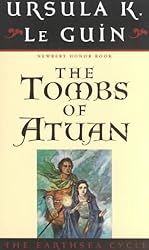
The Tombs of Atuan by Ursula Le Guin
The Tombs of Atuan is the second book in the Earthsea series that began with A Wizard of Earthsea. Wizard is a true classic, and it wouldn't be much criticism to say Atuan doesn't match it. It's true, but The Tombs of Atuan is still well worth the read, quite strong in its own right.
The Tombs of Atuan is a near complete shift of character, setting, and style. Ged, the protagonist of Earthsea, is present, but mostly off-stage for much of the book, giving way to a young girl called Tenar. The setting, rather than an episodic tour of the Earthsea archipelago, is much more narrow, taking place on a single island, in mostly two very limi... Read More
The Tombs of Atuan by Ursula Le Guin
This is the second book in Ursula Le Guin's Earthsea series, but I would hate anyone to think that these books are meant to be read in any particular order. True, the character of Ged ages in each one of them and Tombs was penned by author Ursula le Guin after A Wizard of Earthsea, but... these books are unique. Like The Chronicles of Narnia, many make a big deal about the correct reading order when in fact it's not that big a deal. Think of it like Diana Wynne Jones's Chrestomanci series or even George Lucas's Star Wars trilogy and its prequels. Sometimes things are better when they are read out of c... Read More
The Tombs of Atuan by Ursula Le Guin
The Tombs of Atuan is very different from A Wizard of Earthsea. It focuses on a young woman who has spent her life cloistered in the tombs of gods who she serves but doesn't know. Just as the reader feels completely miserable at the state of this disillusioned young lady, Ged (who nobody would describe as particularly cheerful or up-beat), arrives and brings with him a much-needed ray of sunshine, even though he spends most of the book under the earth.
After Ged's arrival, things start to slowly make more sense to Tenar and it is interesting to watch her well-developed character gradually move from darkness to light.
The Tombs of Atuan is a slow-paced story. There's not a lot of action until the end, but Ged's quest in the tombs is related to the rest of the Earthsea series, so ... Read More
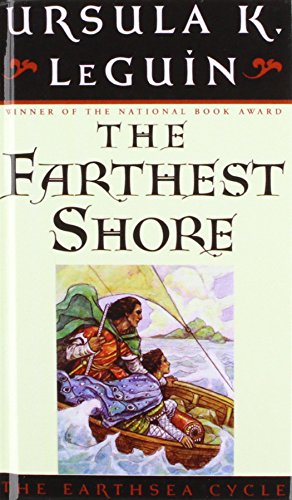
The Farthest Shore by Ursula Le Guin
The Farthest Shore is the third book in Ursula Le Guin's Earthsea series, and the concluding one for several decades. Since it's highly recommended to have read the first two, I'll work on the assumption that the reader has. If book one, Wizard of Earthsea has the most action/magic and book two, Tombs of Atuan, is the slowest and most introspective of the opening trilogy, then The Farthest Shore is a nicely-balanced blending of the styles.
We return to many of the basics from Wizard. Ged is once again the main character instead of a side character as in Atuan, the setting once again moves island to island throughout ... Read More
The Farthest Shore by Ursula Le Guin
This installment takes place a number of years after A Wizard of Earthsea (in which the character Ged was a boy) and The Tombs of Atuan (in which he was a grown man). Now he is edging into late middle-age as the Archmage of the Wizards, and a much younger man has come to the island of Roke, seeking his aid.
Arren is a young prince of the isle of Enlad, eager to serve and awe-struck at the great wizard Ged, but he comes with sobering news. Magic is leaking out of the world, leaving imbalance and chaos in its wake, news that matches reports that the wizards have been receiving from all over Earthsea. A wizard council is held, and Ged announces that he will go forth to find the cause of the magical entropy, and stop it if he can. The untried Arren pledges himself to Ged and his mission, and — despite the trepidation of t... Read More
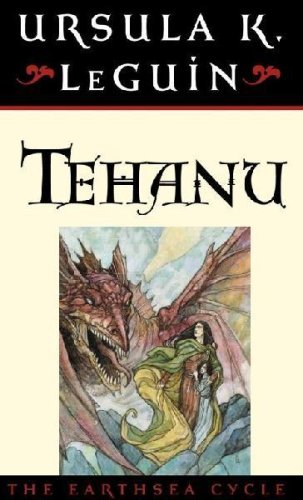
Tehanu by Ursula Le Guin
Hmmm. Where to begin.
First, a confession: despite my high marks for this and other installments of the Earthsea series, I never really warmed up to Ursula Le Guin's masterworks. It's like appreciating a painting by Picasso: I know that it's a magnificent piece of art, but that doesn't mean I'd want it hanging on my living room wall. Likewise, I can recognize the craftsmanship and skill that went into creating The Earthsea Cycle; there's so much skill in the writing, in the detail, in the mythological resonances (everything from Carl Jung to Joseph Campbell). Le Guin also had a masterful grip on the nuances of her story, as in the subtle affinity Tenar shares with thistles. But something kept bothering me, and it wasn't until this forth novel Tehanu that I realised what it was.... Read More
Annals of the Western Shore
Annals of the Western Shore — (2004-2007) Young adult. Powers won the Nebula Award for 2008. Publisher: Scattered among poor, desolate farms, the clans of the Uplands possess gifts. Wondrous gifts: the ability — with a glance, a gesture, a word — to summon animals, bring forth fire, move the land. Fearsome gifts: They can twist a limb, chain a mind, inflict a wasting illness. The Uplanders live in constant fear that one family might unleash its gift against another. Two young people, friends since childhood, decide not to use their gifts. One, a girl, refuses to bring animals to their death in the hunt. The other, a boy, wears a blindfold lest his eyes and his anger kill.


Available for download at Audible.com.
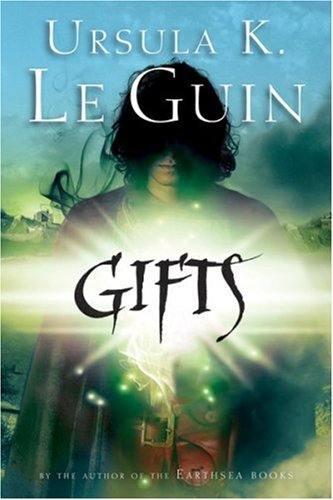
Gifts: Le Guin's usual mastery of story and style
There are lots of reasons to like a good Le Guin novel — her spare prose, her sharpness of description, her ease of storytelling, but in simple terms, when Le Guin writes well (nearly always), it boils down to the fact that reading becomes bare unadorned pleasure. Pleasure at its purest and simplest. And that is the gift of this book.
The backstory is pretty simple — families living in the Uplands have hereditary magical abilities or "gifts" (one type to a family) that can and usually are employed to harm: gifts of "unmaking" (killing/destroying), of "calling" (calling animals — used to call them to be killed), of "twisting" (maiming things and people), of "wasting" (cursing with a slowly fatal illness). The clans feud back and forth over land, cattle, etc. yet must also stay on terms to keep interbreeding as the gifts are strongest when bred... Read More
Gifts by Ursula Le Guin
Bill has written a nice review of Gifts, so I'll just say a couple of things.
Everything Bill says is true, but I didn't like Gifts quite as much as he did because most of the story is told by Orrec as it happened in the past, or as he relates stories that his mother told him. This technique made everything seem less urgent, taking the edge off the excitement and curbing the action. The story is slow and unhappy, though there's a lovely philosophy, if that's what you're in the mood for.
I listened to Gifts on audio. I really enjoyed the audio version. Read More
Voices by Ursula Le Guin
In this story of the Western Shore, we meet Memer, a 17 year old girl — a "siege-brat" — who lives in the occupied land of Ansul, a city of people who used to be peaceful, prosperous, and educated but who were overtaken 17 years ago by the illiterate Alds who consider all writing to be demonic. All of the Ansul literature, history, and other books were drowned... except for a small collection of books that has been saved and hidden in a secret room in the house of Galvamand and can only be accessed by the last two people in the Galva household — Sulter Galva (the Waylord) and Memer, whose mother was a Galva.
One day, the Maker and orator Orrec, and his wife Gry, (from Gifts) come to town, stay at Galvamand, and recite to the people of Ansul and their Ald overlord, the Gand Ioratth. When Orrec recites ancient epics and poetry,... Read More
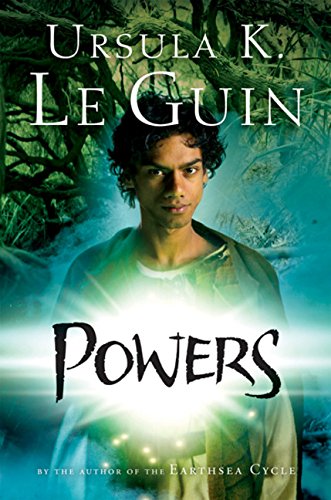
Powers by Ursula Le Guin
Powers is the third and, in my opinion, the best of the Annals of the Western Shore novels. In this book, we meet Gavir, a slave in the City State of Etra. Gavir was born in the marshes but was stolen, along with his sister, by slavers and brought to Etra. He has the power to clearly remember things he has seen before and even some events that have not yet happened to him. This gift is not uncommon in the marshes, but the people of Etra fear powers, so his sister tells him not to speak of it. His memory, however, is prized by the household who owns him and he is being trained to be the teacher of the households' children. He is well treated (except by another slave who holds a grudge against him), well educated, and happy.
But things go awry and Gavir ends up on a journey in which he encounters different people, ideas, and cultures... Read More
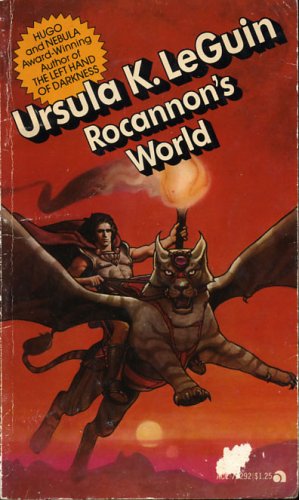
Rocannon’s World by Ursula K. Le Guin
Rocannon’s World, published in 1966, is Ursula Le Guin’s debut novel and the first in her HAINISH CYCLE. The story describes how Rocannon, an ethnographer, became stranded on the planet he was charting when a spaceship from Faraday, a rogue planet that is an enemy to the League of All Worlds, blew up his spaceship and the rest of his crew. Rocannon thinks he’s trapped forever until he sees a helicopter and realizes that Faraday must have a secret base on the planet. If he can find it, he can use its ansible to communicate with the League, not only letting them know that he lives, but also the location of the secret enemy base. (Fun Fact: This is the book that one of Orson Scott Card’s characters in Ender’s Game refers to when he mentions that the word ... Read More
Planet of Exile by Ursula K. Le Guin
Planet of Exile is a novel in Ursula Le Guin’s HAINISH CYCLE and one of the author’s first published books. In this story, a colony of humans has been stranded for many years on the planet Werel, which has such a long orbit around its sun that one year is like 60 Earth years. These humans, gently led by Jakob Agat, live in a city surrounded by a stone wall. Because of the conditions on Werel, especially the effect of its sun’s radiation on human genes, their colony is dwindling. The humans share the planet with two other humanoid species. They have no contact with the Gaal, a nomadic tribe, and they have a tense but sometimes cooperative relationship with the Tevarans.
The planet is moving into its harsh winter phase, which will last about 15 years. Usually when this happens the nomadic Gaal pass by the human city on their way south. But this yea... Read More
City of Illusions by Ursula K. Le Guin
“You go to the place of the lie to find out the truth?”
Ursula K. Le Guin’s HAINISH CYCLE continues with City of Illusions, which I liked better than its predecessors, Rocannon’s World and Planet of Exile. City of Illusions takes place on Earth sometimes in the far future after an alien invasion has killed off most of the people and has completely changed the Earth’s ecology, infrastructure, and geopolitical arrangement. There’s a large capital city run by an alien race called the Shing, but most of the humans are spread out and divided into small clusters in the hinterlands which have gone back to their natural state after Earth’s cities were destroyed. While there are futuristic technologies in the capital, the rest of the people live off the land w... Read More
The Dispossessed by Ursula Le Guin
Because I work in a rock magazine, my officemates were screaming "anarchy, anarchy!" when they caught me reading this book. The Dispossessed is one of the books in the Gollancz SF collection and it certainly deserves its place.
The setting takes place on two planets, one apparently seeming to be utopian and the other its complete opposite. Our protagonist hails from the benevolent planet but he soon discovers that he has no place in either. It's a science-fiction tale with a definite human dimension to it, one that calls to the reader.
It has always amazed me how le Guin can write something as readable as A Wizard of Earthsea and also write something as complex as The Left Hand of Darkness. This book belongs more to the latter category, and beginning readers might find it a diffi... Read More
The Word for World is Forest by Ursula K. Le Guin
Tor recently re-released the Hugo winner The Word for World is Forest by Ursula K. Le Guin in a lovely paperback edition, so I thought it finally was time to check out this famous short novel, originally published in the seventies.
The novel is part of Le Guin’s famous HAINISH CYCLE (see also, among others, The Left Hand of Darkness and The Dispossessed) but can be read completely separately, although being familiar with the larger story will give you a better understanding of the broader context and some of the technologies, such as NAFAL and the famous ansible. Earth-based humans have established a logging colony on the world of New Tahiti and are actively exploiting the pristine world and the indigenous humanoid population, called “creechies” by ... Read More
Other Opinions: The Word for World is Forest

I know this is a classic and I agree with its message, but gee, I feel like Le Guin was wielding a bludgeon here. Ouch! – Kat Hooper
The Telling by Ursula K. Le Guin
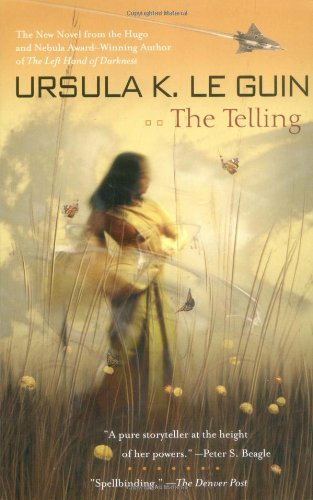
Ursula K. Le Guinis an iconic voice whose books, like Left Hand of Darkness and The Word for World is Forest, made people rethink their assumptions of the society they lived in. She is intimidatingly intellectual but writes characters who are real and full of heart. She is a personal role model of mine, so it’s difficult to write a less-than-glowing review about The Telling, a late entry into Le Guin’s HAINISH CYCLE stories.
This slim novel is more of a philosophical study of the nature of fundamentalism than a complete story. Sutty is an Indo-Canadian language scholar who comes to the planet Aka to study its languages and literature. Space travel takes decades in planetary time; by the time Sutty arrives, sixty years after she left, she discovers a planet that has experienced a cultural revolution. E... Read More
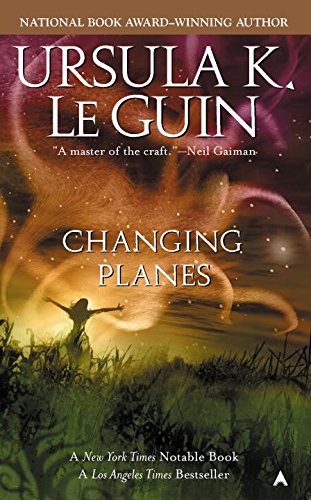
Changing Planes by Ursula K. Le Guin
Airports are horrible places — the boring waits, the noisy rush, the germy stale air, the ugly utilitarian décor, the nasty food. That is, until Sita Dulip, while waiting for her delayed flight from Chicago to Denver and noticing that “the airport offers nothing to any human being except access to the interval between planes,” developed a technique to change planes inside the airport. She discovered that in the airport the traveler is uncomfortable, displaced, and already between planes and can therefore easily slip into other planes of existence while waiting for a flight.
Sita Dulip’s technique has now been publicized and travelers everywhere are using it to alleviate airport boredom. Changing Planes is a collection of fifteen of their stories. A few of the stories are mainly anthropological or linguistic explorations of imaginary cultures, but read... Read More
Lavinia by Ursula Le Guin
"It's not death that allows us to understand one another, but poetry."
Lavinia, wife of Aeneas, is silent in Virgil's Aeneid. In the novel Lavinia, Ursula Le Guin gives a voice and a story to this nearly obscure figure.
I loved the prose from page one. Le Guin's skill with the English language is unquestionable. Here's a sample from early in the novel:
Like Spartan Helen, I caused a war. She caused hers by letting men who wanted her take her. I caused mine because I wouldn't be given, wouldn't be taken, but chose my man and my fate. The man was famous, the fate obscure; not a bad balance.
The concept behind Lavinia is more complicated than you might think. It can on one level be read as a re... Read More
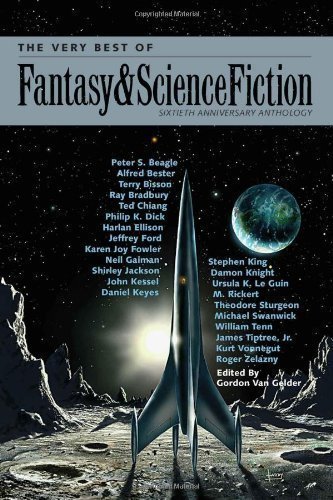
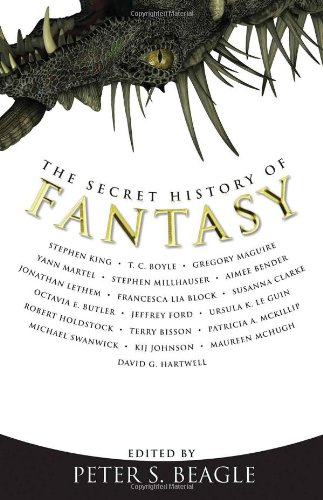
The Very Best of Fantasy & Science Fiction: Sixtieth Anniversary Anthology by Gordon Van Gelder (ed.)
The Very Best of Fantasy & Science Fiction: Sixtieth Anniversary Anthology is an excellent collection of 23 stories picked from the treasure trove of short fiction that's been published in the eponymous magazine over the past 60 years. Editor Gordon Van Gelder — also the editor of the magazine since 1997 — has done an admirable job, picking stories that illustrate the diversity of both the genre and the magazine. As such, this is a great anthology for SF&F fans as well as newcomers looking for a taste.
The line-up of authors in this collection looks like a veritable Who's Who of speculative fiction: Ray Bradbury, Read More
October 12th, 2009.
Stefan Raets´s rating:
4.5 |
Gordon VanGelder,
Harlan Ellison,
Jeffrey Ford,
John Kessel,
Michael Swanwick,
Neil Gaiman,
Peter S. Beagle,
Philip K. Dick,
Ray Bradbury,
Roger Zelazny,
Stephen King,
Ursula K. LeGuin |
Anthology |
SFF Reviews |
no comments

Add to my wishlist View my wishlist
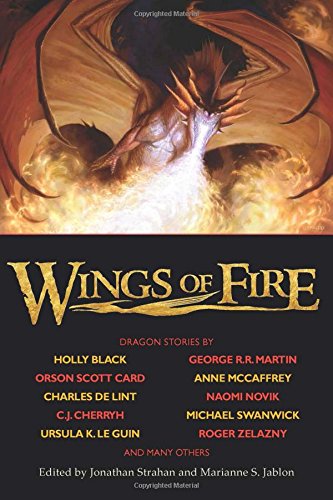
Wings of Fire edited by Jonathan Strahan & Marianne S. Jablon
I don't like dragons.
This is probably not the first sentence you'd expect to find in a review of Wings of Fire, an anthology devoted exclusively to dragon stories, but I thought it best to get it out of the way right from the start.
There's nothing inherently wrong with dragons. They're just terribly overused, one of those tired genre mainstays that people who typically don't read a lot of fantasy will expect in a fantasy novel because they were practically unavoidable for a long time. To this day, I confess to having to suppress a mental groan whenever I encounter them.
For a long time, I actively avoided reading any fantasy novel with the word dragon in the title. Granted, I made several exceptions to this rule in the past, most notably The King's Dragon by Read More
June 16th, 2010.
Stefan Raets´s rating:
4 |
Anne McCaffrey,
C.J. Cherryh,
Charles DeLint,
Elizabeth Bear,
George R.R. Martin,
Holly Black,
James P. Blaylock,
Jane Yolen,
Jonathan Strahan,
Lucius Shepard,
Margo Lanagan,
Michael Swanwick,
Naomi Novik,
Nina Kiriki Hoffman,
Patricia McKillip,
Peter S. Beagle,
Roger Zelazny,
Tanith Lee,
Ursula K. LeGuin |
Anthology |
SFF Reviews |
2 comments

Add to my wishlist View my wishlist
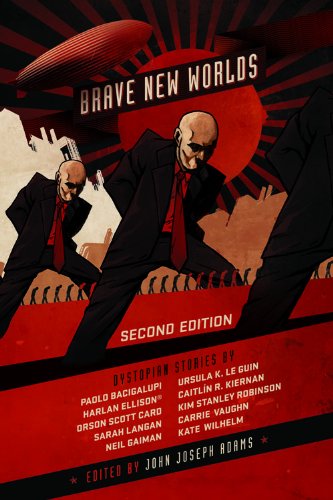
Brave New Worlds: Dystopian Stories edited by John Joseph Adams
Even people who don’t usually read science fiction will often be familiar with a few classic titles in the “dystopian SF” sub-genre. After all, 1984, Fahrenheit 451, and of course the famous Aldous Huxley novel Brave New World are some of the few SF titles that have entered the mainstream literary canon to such an extent that they’ve become assigned school reading for many students. However, novel-length dystopian SF didn’t stop with those venerable classics, and can even be said to be thriving at the moment. See, for example, the recent success of Paolo Bacigalupi’s debut The Windup Girl Read More
February 2nd, 2011.
Stefan Raets´s rating:
5 |
Caitlín R. Kiernan,
Carrie Vaughn,
Charles Coleman (C.C.) Finlay,
Cory Doctorow,
Genevieve Valentine,
Harlan Ellison,
John Joseph Adams,
Kurt Vonnegut,
Neil Gaiman,
Orson Scott Card,
Paolo Bacigalupi,
Philip K. Dick,
Ray Bradbury,
Robert Silverberg,
Tobias Buckell,
Ursula K. LeGuin |
Anthology |
SFF Reviews |
3 comments

Add to my wishlist View my wishlist
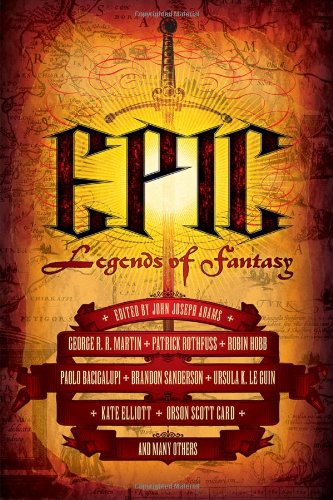
Epic: Legends of Fantasy by John Joseph Adams (editor)
Epic: Legends of Fantasy, edited by John Joseph Adams, is an anthology of stories written by some of the biggest names in epic fantasy. The book clocks in at over 600 pages not just because it’s very difficult to tell short epic stories (though some of these authors do manage to pull it off) but because here the authors are not just telling epic legends, they are legends in and of themselves. George R.R. Martin, Patrick Rothfuss, Robin Hobb, Paolo Bacigalupi, Brandon Sanderson, Ursula K. LeGuin, Kate Elliott, Orson Scott Card, Tad Williams, Aliette de Bodard, Michael Moorcock, Melanie Rawn, Mary Robinette Kowal, N.K. Jemisin, Carrie Vaughn, Trudi Canavan, and Juliet Marillier all contributed stories to this volume.
Epic: Legends of Fantasy opens with a novella by Robin... Read More
December 28th, 2012.
Ruth Arnell´s rating:
4.5 |
Aliette DeBodard,
Brandon Sanderson,
Carrie Vaughn,
George R.R. Martin,
John Joseph Adams,
Juliet Marillier,
Kate Elliott,
Mary Robinette Kowal,
Melanie Rawn,
Michael Moorcock,
N.K. Jemisin,
Orson Scott Card,
Paolo Bacigalupi,
Patrick Rothfuss,
Robin Hobb,
Tad Williams,
Trudi Canavan,
Ursula K. LeGuin |
Anthology |
SFF Reviews |
no comments

Add to my wishlist View my wishlist
More books by Ursula LeGuin
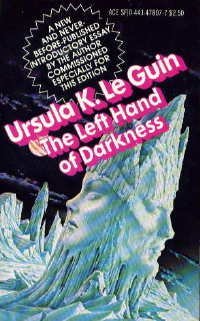
The Left Hand of Darkness — (1969) A science fiction novel which tells the story of Winter, an Earth-like planet where the weather conditions are semi-arctic and the inhabitants are all of the same sex, which is invited to join a coalition of planets.
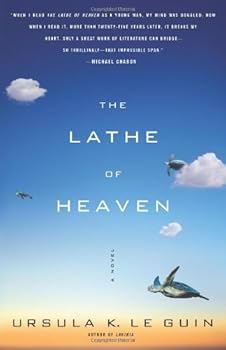
The Lathe of Heaven — (1971) Available for download at Audible.com. Publisher: In a future world racked by violence and environmental catastrophes, George Orr wakes up one day to discover that his dreams have the ability to alter reality. He seeks help from Dr. William Haber, a psychiatrist who immediately grasps the power George wields. Soon George must preserve reality itself as Dr. Haber becomes adept at manipulating George’s dreams for his own purposes. The Lathe of Heaven is an eerily prescient novel from award-winning author Ursula K. Le Guin that masterfully addresses the dangers of power and humanity’s self-destructiveness, questioning the nature of reality itself. It is a classic of the science fiction genre.
The Eye of the Heron — (1978) Publisher: In Victoria on a former prison colony, two exiled groups–the farmers of Shantih and the City dwellers–live in apparent harmony. All is not as it seems, however. While the peace-loving farmers labor endlessly to provide food for the City, the City Bosses rule the Shantih with an iron fist. When a group of farmers decide to from a new settlement further away, the Bosses retaliate by threatening to crush the “rebellion.” Luz understands what it means to have no choices. Her father is a Boss and he has ruled over her life with the same iron fist. Luz wonders what it might be like to make her own choices. To be free to choose her own destiny. When the crisis over the new settlement reaches a flash point, Luz will have her chance.
Malafrena — (1979) Publisher: Malafrena is not a real place. Itale never dreamed of love, nor Piera of him. Estenskar did not live, only his poems. Only the dreams of themselves are real, only their youth, only the wind called Freedom that swept through their lives like a storm unforgettable. A novel set in the imaginary nation of Orsinia in the early nineteenth century.
The Beginning Place (Threshold) — (1980) Publisher: A magical place across a creek provides sanctuary for two young people in flight from the banality of their daily lives, until their paradise turns into a hell on Earth that threatens to destroy them.
Always Coming Home — (1985) Publisher: A complex interweaving of the story and fable, poem and artwork, brings to life the culture of Kesh, a peaceful people of the far future who inhabit a place called the Valley on the Northern Pacific coast.
A Ride on the Red Mare’s Back — (1992) Ages 4-10. Publisher: With the aid of her magic wooden horse, a brave girl travels to the High House in the mountains to rescue her kidnapped brother from the trolls.

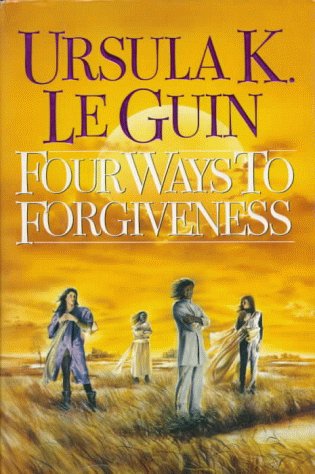
Four Ways to Forgiveness — (1995) A collection of four linked novellas. Two planets — Werel, a slave-owning oligarchy and Yeowe, its colony — are destined for revolution after contact with the sophisticated Ekumen civilization. But one form of oppression can too easily give way to another, and so a new fight for equality begins.

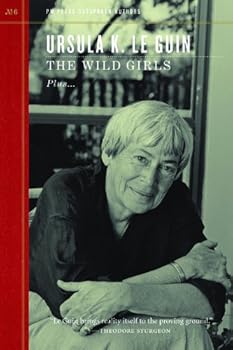
The Wild Girls — (2011) Publisher: Newly revised and presented here in book form for the first time, this Nebula Award-winning story tells of two captive “dirt children’ in a society of sword and silk, whose determination to find a glimpse of justice leads to a violent and loving end. Also included is the nonfiction essay “Staying Awake While We Read” which demolishes the pretensions of corporate publishing and the basic assumptions of capitalism, and “Outspoken Interview,’ which reveals the hidden dimensions of America’s best-known sci-fi author.
Outer Space, Inner Lands – (2012) Publisher: Outer Space, Inner Lands includes many of the best known Ursula K. Le Guin nonrealistic stories (such as “The Ones Who Walk Away from Omelas,” “Semley’s Necklace,” and “She Unnames Them”) which have shaped the way many readers see the world. She gives voice to the voiceless, hope to the outsider, and speaks truth to power—all the time maintaining her independence and sense of humor. Companion volume Where on Earth explores Le Guin’s satirical, risky, political and experimental earthbound stories. Both volumes include new introductions by the author.
Story collections: