Deathworld
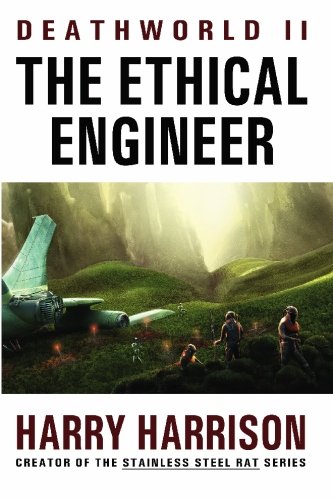
Deathworld — (1960-1968) Publisher: DEATHWORLD centers on Jason dinAlt, a professional gambler who uses his somewhat erratic psionic abilities to tip the odds in his favor. He is challenged by a man named Kerk Pyrrus (who turns out to be the ambassador from the planet Pyrrus) to turn a large amount of money into an immense sum by gambling at a government-run casino. He succeeds and survives the planetary government’s desperate efforts to steal back the money. In a fit of ennui, he decides to accompany Kerk to his home, despite being warned that it is the deadliest world ever colonized by humans… DEATHWORLD! DEATHWORLD is one of the classics of the Golden Age of science fiction, born in the pages of Astounding Science Fiction under the editorship of John W. Campbell, Jr.
Original Trilogy: Omnibus


Brion Brandd
Brion Brandd — (1962,1981) Publisher: A series of two novels featuring Brion Brandd, the superhuman champion of “The Twenties”, a competition of 20 tasks, both physical and cerebral. He also works for the Cultural Relationships Foundation, a private body which exists to ‘promote peace and ensure the sovereign welfare of independent planets.’
More science fiction from Harry Harrison
The Man from P.I.G. — (1968,1974) Publisher: Bron Wurber is a pig farmer with a degree in animal husbandry and a doctorate in galactic politics. His pigs are specially trained and bred, and form a special taskforce, P.I.G. — the Porcine Interstellar Guard. Their task in this humorous tale is to help the people of the planet Towbri, and defeat the monsters of the Ghost Plateau.


Tony Hawkin — (1972,1974) Publisher: Tony Hawkin — an Apache Indian and manager of the book and print shop in Washington’s National Gallery — is recruited as an art expert by the FBI to help them recover a stolen painting by Leonardo da Vinci. Hawkin has special attributes that explain his recruitment: he can speak Spanish, he knows about paintings, and there’s no one else available.


To the Stars — (1980-1981) Publisher: In this story of post-Twentieth Century Earth, Man has recovered from the disaster wrought by the Wasters who used up the planet’s reserves of fossil fuels and overpopulated the planet. The all-powerful oligarchical governments which guided the people through the bad times have retained their powerful positions. The population of Britain is divided into two classes, the executive class and the proles. Unemployment runs at 90% among the proles, while the upper-class lives comfortably. Jan Kulozik is an engineer from the upper class. Rescued from a boating accident by an Israeli spy-sub, he learns of Israel, the only remaining democratic state, where all men are equal. He begins to question his own role as a ‘slave master’, and becomes involved with the Israeli underground back in England. Homeworld is a bleak future vision, a post-microchip version of Orwell’s 1984, where the all powerful security forces watch every move and plot lives as though they are pawns in a chess game. ‘To The Stars’ comes from a line in the final, optimistic, speech at the end of the H.G. Wells film The Shape of Things To Come.


Eden — (1984-1988) Publisher: Sixty-five million years ago, a disastrous cataclysm eliminated three-quarters of all life on Earth. Overnight, the age of dinosaurs ended. The age of mammals had begun. But what if history had happened differently? What if the reptiles had survived to evolve into intelligent life? In West of Eden, Harry Harrison has created a rich, dramatic saga of a world where the descendants of the dinosaurs struggled with a clan of humans in a battle for survival.


The Hammer and the Cross — (1993-1996) Publisher: 865 A.D. Warring kings rule over the British Isles, but the Church rules over the kings, threatening all who oppose them with damnation. Only the dreaded Vikings of Scandinavia do not fear the priests. Shef, the bastard son of a Norse raider and a captive English lady, is torn by divided loyalties and driven by strange visions that seem to come from Odin himself. A smith and warrior, he alone dares to imagine new weapons and tactics with which to carve out a kingdom — and launch an all-out war between… The Hammer and the Cross.


Stars and Stripes — (1998-2001) Publisher: On November 8, 1861, a U.S. navy warship stopped a British packet and seized two Confederate emissaries on their way to England to seek backing for their cause. England responded with rage, calling for a war of vengeance. The looming crisis was defused by the peace-minded Prince Albert. But imagine how Albert’s absence during this critical moment might have changed everything. For lacking Albert’s calm voice of reason, Britain now seizes the opportunity to attack and conquer a crippled, war-torn America. Ulysses S. Grant is poised for an attack that could smash open the South’s defenses. In Washington, Abraham Lincoln sees a first glimmer of hope that this bloody war might soon end. But then disaster strikes: English troops have invaded from Canada. With most of the Northern troops withdrawn to fight the new enemy, General William Tecumseh Sherman and his weakened army stand alone against the Confederates. Can a divided, bloodied America defeat England, or will the United States cease to exist for all time?


Make Room! Make Room! — (1966) Publisher: The world is crowded. Far too crowded. Its starving billions live on lentils, soya beans, and — if they’re lucky — the odd starving rat. In a New York City groaning under the burden of 35 million inhabitants, detective Andy Rusch is engaged in a desperate and lonely hunt for a killer everyone has forgotten. For even in a world such as this, a policeman can find himself utterly alone…. Acclaimed on its original publication in 1966, Make Room! Make Room! was adapted into the movie Soylent Green in 1973, starring Charlton Heston along with Edward G. Robinson in his last role.
The Technicolor Time Machine — (1968) Publisher: Barney Hendrickson is a film-producer for ailing Climactic Studios. In a last-ditch attempt to save the company he persuades the boss to finance his new picture, Viking Columbus, the story of how the Vikings arrived in America years before Columbus. The movie will be made on a low budget with no need to build sets and long boats, or pay extras, because they will use Professor Hewitt’s prototype time machine to take the crew back in time to the actual time and location when the Viking landing actually occurred. Time Machine spoofs both time travel stories and the business of Hollywood filmmaking. The novel was dramatised for radio by the BBC.

Spaceship Medic — (1970) Publisher: The spaceship Johannes Kepler is travelling the routine 92-day trip between Lunar Station and Mars when it is hit by a meteorite. The Captain and all senior crew members were holding a meeting and were killed by the impact. The only officers left are First Engineer Holtz, who refuses to leave the engine room and Lieutenant Donald Chase, a young doctor in his first post. Chase finds himself in charge of a badly damaged ship, with a crew trained simply to obey orders, and over 100 passengers on the brink of panic. The novel follows his attempts to improvise solutions to problems which arise as they nurse the ship on towards Mars.

The Jupiter Plague — (1982) Publisher: Formerly titled Plague From Space. Publisher: The spaceship Pericles returns from a manned flight to Jupiter. The surviving crew member returns with a hideously disfiguring disease. Doctor Bertolli is first on the scene, and is one of the key figures who must try and protect the human race from an epidemic which threatens it with extinction.

Invasion: Earth — (1982) An alien spacecraft plummets to Earth, passing between the twin towers of the World Trade Center and coming to rest in Central Park. Two very different aliens survive, an Oinn and a Blettr, seemingly the bitterest of enemies, one captor, one captive. But when battle fleets from both races converge on Earth, it is discovered that the two races are in league, their plan: to invade Earth. It is left to Colonel Rob Hayward to plan the defence of the planet, with the Russians his allies against this outside threat.
A Rebel in Time — (1983) Publisher: Can history be changed? Can the south still win the War Between the States? Colonel McColloch thinks so… and his gold, his gun, and some very special blueprints stand behind him to help him prove it. Sargeant Harmon is a black man who hopes not… and only his readiness, ingenuity, and wit stand behind him to help him stop it. In the corridors of contemporary Washington and on the fields where Civil War battles have yet to be fought, these two men take each other on — and the winner will determine the course of history….
Captive Universe — (1969) Publisher: Chimal lives in an Aztec valley, where the serpent-headed goddess, Coatlicue, walks. When Chimal notices that all creatures entering the valley seem to come from the same place, he goes to investigate. Leaving the valley, he discovers that it is contained in a ‘generation starship’, which is run by a group who live lives similar to those of medieval monks. Chimal first adjusts to life outside the valley, then sets about liberating the inhabitants of the ship. This is regarded as one of Harrison’s most literary novels.
The Daleth Effect — (1970) Also published as In Our Hands, the Stars. Publisher: Top Israeli scientist, Arnie Klein, ‘defects’ to Denmark in order to protect his discovery, the secret of simple, economic space travel by use of the ‘Daleth effect’. He wishes to develop the idea without it falling into the hands of the military, since it also has potential as a weapon. But he is forced to reveal his secret to the world when the Daleth effect unit is fitted to a submarine which is sent into space to rescue two stranded Soviet cosmonauts. Klein and his friends are then subjected to all kinds of international pressure from people wanting the secret. This is a novel about the misuse of scientific discovery, and was listed by Stanley Schmidt as one of the ’10 SF Books For Scientists.’
A Transatlantic Tunnel, Hurrah! — (1972) Also published as Tunnel Through the Deeps. Publisher: Over 4,000 miles in length, intended to sustain a pressure of 1,000 atmospheres while accommodating cargo and passengers traveling in excess of 1,000 miles per hour, the Transatlantic Tunnel is the greatest engineering feat in the history of the British Empire, a project worthy of Her Majesty’s Empire in this the eighth decade of the twentieth century. If the project is a success, the credit will belong to Captain Augustus Washington, the most brilliant engineer of our age. It is Washington’s greatest hope that his success will at last erase the family shame inspired by that other Washington, George, traitor to his King, who was hanged by Lord Cornwallis more than two centuries ago.
Star Smashers of the Galaxy Rangers — (1974) Publisher: The wild, galaxy-hopping adventures of brash young scientists Jerry Courtenay and Chuck van Chider are at the core of this classic space opera. When the two college students develop a faster-than-light space drive in their homemade workshed, they decide to sneak it aboard their football team’s airplane as a prank. The boyish plan backfires, however, and the boys find themselves, along with their crush Sally and the seemingly loveable school caretaker, Old John, hurtling through the solar system towards Titan — an icy moon of Saturn inhabited by hideous ice creatures. Titan and the 20th century are only square one as the foursome becomes embroiled in a vast, intergalactic, century-jumping battle.
The Lifeship — (1976) Also published as Lifeboat. According to The Encyclopedia of Science Fiction (ed. Peter Nicholls), Harrison was “filmed at a working lunch with (John W.) Campbell and Gordon R. Dickson which resulted in the Harrison-Dickson collaborative novel Lifeboat. Giles Steel Ashad is a crew member on a galactic liner which is sabotaged by a bomb. The passengers and crew are evacuated and Ashad finds himself in a small ‘lifeboat’ with a group of human slaves, and two alien crewmen. The aliens are the only ones who can pilot the ship, but they have lost the will to live. Ashad must find solutions to this and any other problems which arise.
Skyfall — (1976) The 2,000 tonne Prometheus is a joint Soviet-American space station designed to harness solar energy, to replace the dwindling supply of fossil fuels. The crew of six live in cramped quarters, but their personal problems soon pale when the satellite’s orbit begins to decay. If it hits the Earth, its radioactive power plant will explode with the force of an atom bomb. Skyfall combines political thriller and a disaster story, with space technology based on designs already planned by scientists. Technical advice for the novel was provided by Gerry Webb, F.B.I.S.