Are we missing a book that should be on this page?
Please submit.
Matthew Hughes

(1949- )
Matthew Hughes has made a living as a writer all of his adult life, first as a journalist, then as a staff speechwriter to the Canadian Ministers of Justice & Environment, and lastly as a freelance corporate and political speechwriter in British Columbia. Besides speculative fiction, he also writes crime fiction as Matt Hughes and media tie-ins as Hugh Matthews. You can read excerpts and purchase his e-books at
Matthew Hughes’ friendly website.
Majestrum by Matthew Hughes
Majestrum is a relatively short (232 page trade paperback) science fantasy set in our own far-future universe which has been colonized far and wide by humans from “Old Earth.” The protagonist, Henghis Hapthorn, is a “discriminator” (“he unravels conundrums, picks apart puzzles, uncovers enigmas”) who uses his keen logical skills to solve mysteries.
But some strange stuff is going on: Mr Hapthorn's integrator (a sentient computer which assists him in his work) has recently donned flesh and blood and become more like a familiar than a computer. Also, the small intuitive part of Henghis's psyche has suddenly asserted itself as a separate personality which shares Henghis's brain and body. These occurrences seem to indicate that sympathetic association (magic), which waxes and wanes across the eons, is now rising again. And soon Henghis Hapthorn's double pers... Read More
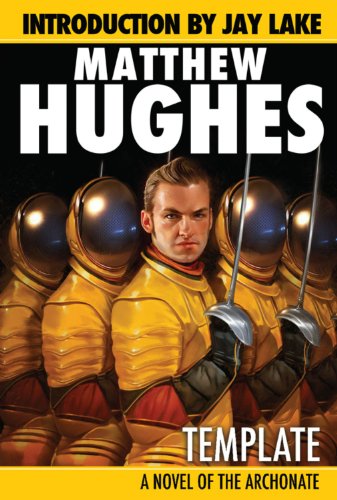
Template by Matthew Hughes
Template opens with an exciting scene as the protagonist, Conn, a skilled swordsman, successfully defends himself from three opponents. You'd think this would turn into another action/adventure SF novel but Template instead drifts into mystery and philosophy as our protagonist suddenly finds himself with various choices when he previously had none.
Conn is likable enough at the start although later on we discover that his paradigms are alien. This becomes a recurring theme as Matthew Hughes presents planets and races with varying ethics, which enables him to insert philosophical discourse in a way that flows naturally with the story.
The language is easy to get into and quite functional. The text isn't too long but what Hughes lacks in density, he makes up for with his pacing and depth.
Where Te... Read More
To Hell and Back
To Hell and Back — (2011-2012) Publisher: After accidentally summoning a demon, the mild-mannered Chesney Anstruther refuses to sign the contract, causing Hell to go on strike. But with no demons to tempt mankind, the world becomes a strange and boring place. To settle the strike, a deal is struck between Satan and Chesney, and thus the strangest superhero duo ever seen — in Hell or on Earth — is born!


To Hell and Back: The Damned Busters by Matthew Hughes
CLASSIFICATION: The Damned Busters is a whimsical PG-13 urban fantasy novel that combines the supernatural and superheroes with comedy and romance.
FORMAT/INFO: The Damned Busters ARC is 239 pages long divided over 12 numbered chapters. Narration is in the third-person, exclusively via the protagonist Chesney Arnstruther. The Damned Busters is self-contained, but is the first volume in the To Hell and Back series, which has a sequel — Costume Not Included— scheduled for publication in 2012. May 5, 2011/May 31, 2011 marks the UK/North American Mass Market Paperback publication of To Hell and Back: The Damned Busters via Angry Robot. Cover art is provid... Read More
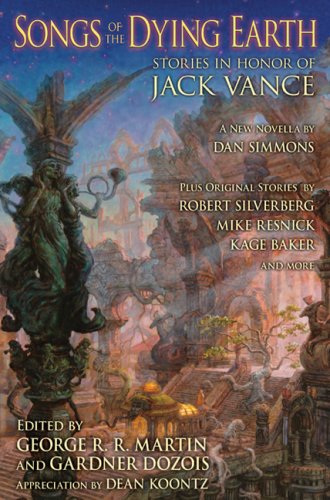
Songs of the Dying Earth: Stories in Honor of Jack Vance edited by George R.R. Martin & Gardner Dozois
Songs of the Dying Earth: Stories in Honor of Jack Vance is the best anthology I’ve ever read. These stories will be enjoyed by any SFF reader, but they’ll be ten times more fun if you’ve read Jack Vance’s The Dying Earth, because they are all written in honor of that fantastic work. Each tale is written in the style of Vance, which is quite amusing in itself, and each takes place on the Dying Earth, that far-future wasteland in which natural selection means survival of the cleverest, nastiest, sneakiest, and most self-serving.
Songs of the Dying Earth was written by “many high-echelon, top-drawer writers” (as Mr. Vance says in the preface):... Read More
May 7th, 2010.
Kat Hooper´s rating:
5 |
Dan Simmons,
Elizabeth Hand,
Elizabeth Moon,
Gardner Dozois,
George R.R. Martin,
Glen Cook,
Jack Vance,
Jeff VanderMeer,
John C. Wright,
Kage Baker,
Liz Williams,
Matthew Hughes,
Mike Resnick,
Neil Gaiman,
Paula Volsky,
Phyllis Eisenstein,
Tad Williams,
Tanith Lee,
Walter Jon Williams |
Anthology,
Audio |
SFF Reviews |
4 comments

Add to my wishlist View my wishlist
More books by Matthew Hughes
Luff Imbry — (2010-2012) Publisher: Meet Luff Imbry, an insidiously clever confidence man… He likes good wine, good food, and good stolen goods, and he always maintains the upper hand. When a business rival gets the drop on him, he finds himself abandoned on Fulda — a far-off, isolated world with a history of its own. Unable to blend in and furious for revenge, Imbry has to rely on his infamous criminal wit to survive Fulda’s crusade to extinguish The Other. Hailed as the heir apparent to Jack Vance, Matthew Hughes brings us this speculative, richly imagined exploration of society on the far edges of extreme. A central character in Black Brillion, Luff Imbry is at last front and center in Hughes’s latest rollercoaster adventure through a far-future universe.


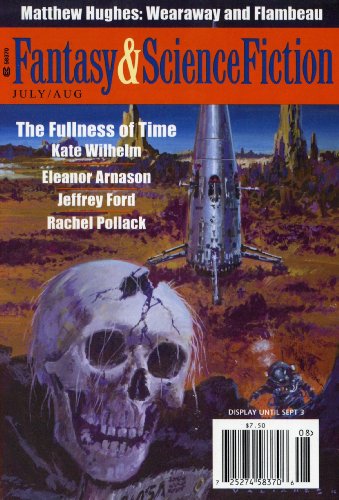
The novella is the ideal length for a science fiction story. It’s long enough to allow a reader to become immersed in a scene and involved with the characters; and it’s short enough to allow a reader to suspend disbelief as to the more unscientific or strange aspects of a story without questioning them too closely. Kate Wilhelm’s “The Fullness of Time,” which forms the backbone of the July/August issue of The Magazine of Fantasy & Science Fiction, is a fine illustration of the strengths of the novella form.
“The Fullness of Time” is about a documentary film maker, Cat, who hires a researcher, Mercedes, the first person narrator of the tale, to work on a project about Hiram Granville, a famous inventor, now dead, about whom littl... Read More
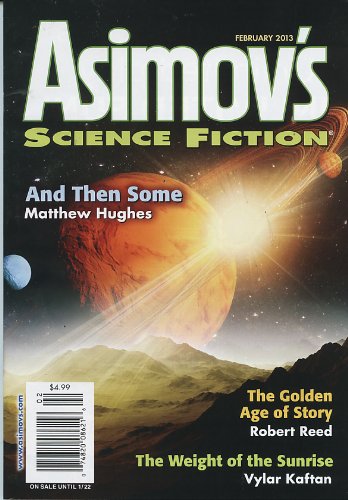
The February 2013 issue of Asimov’s is a delight from cover to cover. This time around, it’s the longer pieces that really given it is heft.
“The Weight of the Sunrise” by Vylar Kaftan is a fascinating alternate history novella that offers a pointed perspective on American history, serving as a sort of bookend to the recent film, “Lincoln.” Slavery was an evil obvious even to those who practiced human sacrifice and saw nothing wrong with incestuous marriages of royalty, as did the Incas, as Kaftan makes clear. Kaftan envisions an Incan civilization that has escaped the ravages of Spanish conquistadors with military cunning. Smallpox still troubles the Incas, though they have learned in this tale, unlike in life, to manage it through quarantine, thanks to the insight of a great physician. This makes it a strong and wealthy civilization in the 18th century when the Americans are planning for revolution. The Americans send an ambassador to t... Read More
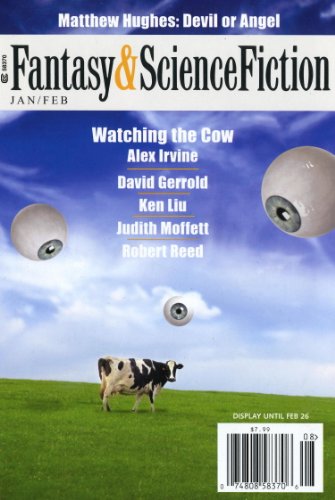
The latest issue of F&SF is stuffed with good reading. I can’t pick a favorite, as I often do; many of the stories hit that sweet spot. Robert Reed’s short story, “Among Us,” is a good example: it’s about the Neighbors, creatures who look exactly like humans but are not, though they may not know that themselves. The narrator studies the Neighbors in every way possible — almost. There comes a moment when he is not willing to let research take its course, and whether that proves something to him, to the researchers, or to the Neighbors themselves (or even all three at once) is not entirely clear. Reed's story is full of wonder, which is why he remains one of the best short story writers in the field.
“The Blue Celeb” by Desmond Warzel, another fine story, tells the tale of two men who opened a barbershop together in Harlem after they returned from Vietnam. They’ve watched the neighborhood around them change over the years,... Read More
Here's another installment of FanLit Asks. Instead of asking one author several questions, we’ve asked several authors just one question. Please leave a comment or suggest a question for us to ask in the future. We’ll choose one commenter to win a copy of Jack Vance's The Eyes of the Overworld(one of my favorites!) on audio CDs (or, if you've got bad taste, something else from our stacks).
Question: Which speculative fiction writer has had the greatest influence on your own writing style and what, specifically, do you find most inspirational about that writer’s style?
Alex Bell: Definitely Terry Pratchett. His Discworld novels got me... Read More
Array
(
[SERVER_SOFTWARE] => Apache
[REQUEST_URI] => /fantasy-author/hughesmatthew/
[DOCUMENT_ROOT] => /home3/fantatn0/public_html
[GATEWAY_INTERFACE] => CGI/1.1
[HTTP_ACCEPT] => text/html,application/xhtml+xml,application/xml;q=0.9,*/*;q=0.8
[HTTP_ACCEPT_ENCODING] => gzip
[HTTP_ACCEPT_LANGUAGE] => en-us,en-gb,en;q=0.7,*;q=0.3
[HTTP_CF_CIP_TAG] => 0
[HTTP_CF_CONNECTING_IP] => 23.22.76.170
[HTTP_CF_IPCOUNTRY] => US
[HTTP_CF_RAY] => 707dfaf102802b9
[HTTP_CF_VISITOR] => {\"scheme\":\"http\"}
[HTTP_CF_WAN_ENCODING] => 0
[HTTP_CF_WAN_ID] => 0
[HTTP_CONNECTION] => Keep-Alive
[HTTP_HOST] => www.fantasyliterature.com
[HTTP_USER_AGENT] => CCBot/2.0
[HTTP_X_FORWARDED_FOR] => 23.22.76.170
[HTTP_X_FORWARDED_PROTO] => http
[PATH] => /bin:/usr/bin
[QUERY_STRING] =>
[REDIRECT_STATUS] => 200
[REDIRECT_URL] => /fantasy-author/hughesmatthew/
[REDIRECT_W3TC_ENC] => _gzip
[REDIRECT_file_gzip] => /ramdisk/cpud/status
[REMOTE_ADDR] => 23.22.76.170
[REMOTE_PORT] => 32815
[REQUEST_METHOD] => GET
[SCRIPT_FILENAME] => /home3/fantatn0/public_html/index.php
[SCRIPT_NAME] => /index.php
[SERVER_ADDR] => 69.195.124.64
[SERVER_ADMIN] =>
[email protected]
[SERVER_NAME] => www.fantasyliterature.com
[SERVER_PORT] => 80
[SERVER_PROTOCOL] => HTTP/1.1
[SERVER_SIGNATURE] =>
Apache Server at www.fantasyliterature.com Port 80
[file_gzip] => /ramdisk/cpud/status
[PHP_SELF] => /index.php
[REQUEST_TIME] => 1368873044
[argv] => Array
(
)
[argc] => 0
)