Are we missing a book that should be on this page? Please submit.
Suzanne Collins
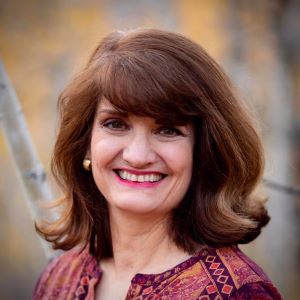
Suzanne Collins writes for children’s television. She has worked on the staffs of several Nickelodeon shows, including the Emmy-nominated hit Clarissa Explains it All and The Mystery Files of Shelby Woo. She lives in Connecticut with her family. Learn more at Suzanne Collins’ website.
The Underland Chronicles
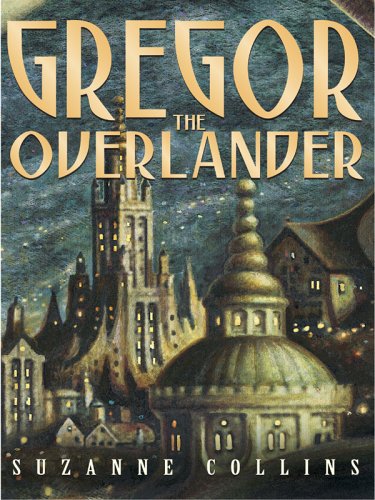
The Underland Chronicles — (2003-2007) Ages 9-12. Publisher: When Gregor falls through a grate in the laundry room of his apartment building, he hurtles into the dark Underland, where spiders, rats, cockroaches coexist uneasily with humans. This world is on the brink of war, and Gregor’s arrival is no accident. A prophecy foretells that Gregor has a role to play in the Underland’s uncertain future. Gregor wants no part of it — until he realizes it’s the only way to solve the mystery of his father’s disappearance. Reluctantly, Gregor embarks on a dangerous adventure that will change both him and the Underland forever.
In the sea of young adult fiction out there, Gregor the Overlander makes for one of the more pleasant anchorages. The book starts off quickly with Gregor and his two-year-old sister "Boots" falling through a gateway into the Underworld, a sprawling underground land populated by giant talking cockroaches, rats, bats, and spiders, along with several thousand pale humans descended from a 17th century "overlander" who led his small group into the Underworld then sealed the entrances. This descendant left a string of prophecies, including one which seems to point directly to Gregor as the one who may or may not save the humans in their ongoing war with the rats (as is often the case with prophecies, this one is somewhat lacking in clarity). Gregor has a more personal issue at stake; it turns out his father, who had disappeared a few years earlier, had also fallen through i... Read More
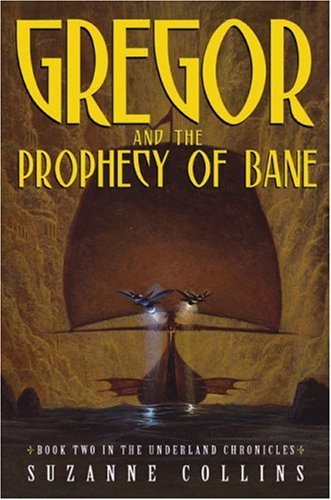
Gregor and the Prophecy of Bane by Suzanne Collins
The Prophecy of Bane continues the strengths displayed in Suzanne Collins' first book in the series, Gregor the Overlander. The book moves along quickly and smoothly with few if any slow spots; the major characters, if not minutely detailed, have enough personality and reality to hold one's interest and concern; and the setting, which as in the first is probably the weakest element in terms of vividness, is at least interesting enough in general terms so that its lack of detail is not much of a flaw.
As in book one, Gregor enters the Underworld to save a family member. In book one it was his father; here it is his little sister Boots. One sees the freshness and originality early on in the book as the quest quickly changes from what the reader first assumes it will be — the search for Boo... Read More
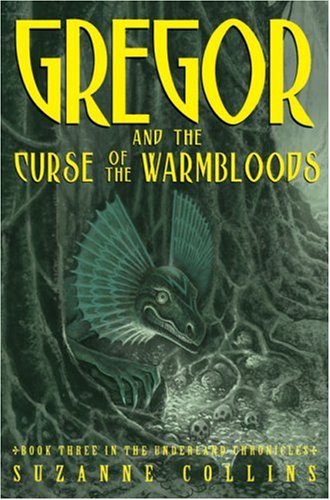
Gregor and the Curse of the Warmbloods by Suzanne Collins
The third book in the Gregor series picks up shortly after the last one ends and quickly tosses the reader into familiar territory. Once again, Gregor takes up a task underground in order to save a family member. In the first book it was his father, in book two his sister Boots, and now it's his mother, who in accompanying him down to the underground contracted a seemingly fatal disease that threatens to wipe out the warmbloods.
As foretold by a prophecy (another familiar element from the other books), Gregor joins a group made up of rats, crawlers, humans, and bats who have put aside (somewhat) their hatred for each other to seek the cure to this plague that strikes them all. The quest will take them deep into a dangerous forest, the only place where the plant that supposedly holds the cure grows.
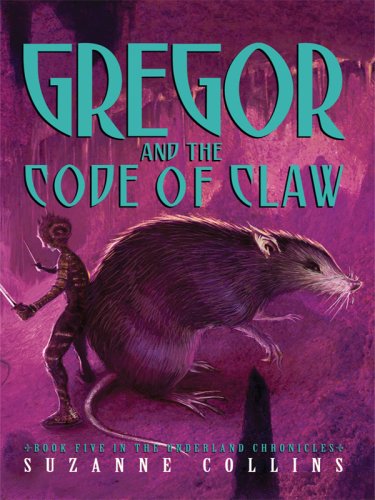
This is the fifth and series-ending (I shy from ever using the word “final” with regard to fantasy nowadays) book in the Gregor series, one of the most original and powerful young adult fantasy series now in recent years. It is not a standalone book, so if you haven’t read the first four, you should start. Assuming you have, however, how does Code stack up?
I have to admit to some disappointment. While much of what has made Gregor such a strong series can be found here: strongly distinct characters, a quick pacing, truly moving scenes, a realistic approach to violence and its consequences seldom seen in most books (young adult or not), Code doesn’t quite match the quality of the earlier books.
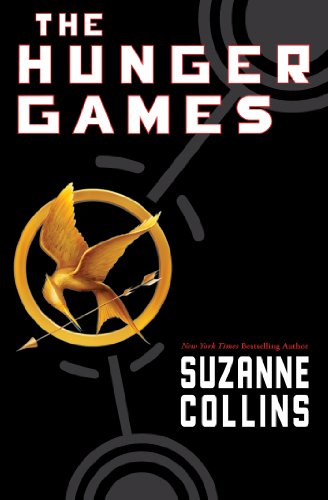
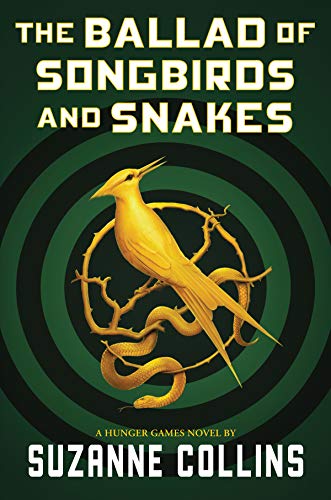
The Hunger Games — (2008-2010) Young Adult. Publisher: Katniss is a 16-year-old girl living with her mother and younger sister in the poorest district of Panem, the remains of what used be the United States. Long ago the districts waged war on the Capitol and were defeated. As part of the surrender terms, each district agreed to send one boy and one girl to appear in an annual televised event called, “The Hunger Games.” The terrain, rules, and level of audience participation may change but one thing is constant: kill or be killed. When Kat’s sister is chosen by lottery, Kat steps up to go in her place.
Suzanne Collins has already proven her talent for storytelling with her recently completed Gregor the Underlander series. In that series, she showed she was able to create strong characters, move plot along quickly, deftly control the rise and fall in tension, and create moving scenes. While there were some weak sections in the series (sometimes the pace moved too quickly, settings often could have been more detailed, and a few characters could have been more richly drawn), by the end she had crafted one of the best YA series to hit the shelves the past few years — a thoughtful, often dark, almost always rewarding series.
I'm happy to report that with book one of The Hunger Games, there is no sophomore slump. In fact, Suzanne Collins returns with a starting book that is more tightly focused, more moving, more quickly p... Read More
What can I say that hasn’t already been said? The Hunger Games has been getting lots of buzz, and by the time I was a few pages in, I knew it was all deserved.
And then it got better.
The Hunger Games takes place in the future, in a dystopian nation that arose from the ruins of the United States. Panem consists of twelve Districts and is ruled from a decadent Capitol. (Try Googling “Panem” to get the play on words. I’m sad to say I missed the reference while reading!) Every year, to underscore its domination of the Districts, the government demands a tribute of one girl and one boy per District. These adolescents are thrown into a vast, wilderness-filled arena, in which they fight to the death while Panem watches on television. This society is very different from our own, but just similar enough to be chilling. S... Read More
Sometimes it is nice to be wrong. As a general rule when it comes to young adult urban fantasy I try to stay well away from the mainstream authors. The rule for me has been that if my 16-year-old is reading it and loving it, then I will steer clear of it. In the case of The Hunger Games, I was dead wrong.
Suzanne Collins' take on a post-apocalyptic North America is a cross somewhere between an Orwellian controlled series of city-states and E.E. Knight's Vampire Earth, minus the vampires. Collins does a tremendous job of giving us a bleak, harsh reality from the beginning and uses the hard facts of life to give the story a believable premise. This is not simply a heroine who happ... Read More
The news that Suzanne Collins’s The Hunger Games is coming out in movie form in March 2012 finally moved me to read this book, which one of my young nephews has recommended to me with extravagant praise. That nephew is going to be a darned good literary critic when he grows up, because he’s absolutely right: The Hunger Games is an excellent adventure with plenty of depth to it.
Suzanne Collins clearly set out to make The Hunger Games a book that older as well as younger readers can enjoy. The setting is a dystopia of the future, in a world where the United States no longer exists. It has been replaced, at least in large part, by a country known as Panem. Panem consists of the Capitol (apparently somewhere around what we now know as Denver, Colorado) and 12 Districts, each with a sp... Read More
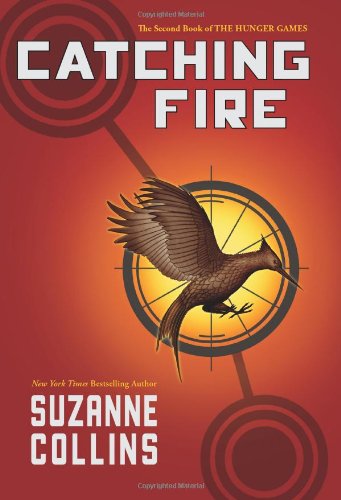
One of last year’s best, most compelling reads was Suzanne Collins’ dystopic The Hunger Games, in which a group of young boys and girls are sent into a large geographic area for a kill-or-be-killed TV spectacle — a sort of Running Man meets Lord of the Flies meets Survivor meets The Lottery. The book, carried along winningly by the strong main character Katniss, was suspenseful, poignant, and often breathless, ending with a clear resolution but with an obvious nod toward a sequel. That sequel is Catching Fire, and while it’s not as good as The Hunger Games, nor as breathlessly compelling (both tough standards to equal), it’s a strong follow-up. Read More
After finishing the unputdownable The Hunger Games, I couldn’t wait to see what was in store for Katniss Everdeen and her friends in Catching Fire. As it turns out, quite a lot.
Catching Fire picks up six months after The Hunger Games left off. Katniss and Peeta have uneasily integrated themselves back into their lives and families in District 12, albeit with money and fame. Katniss is still torn between her two possible love interests: Peeta, whom she pretended to love in order to stay alive in the arena, and Gale, her childhood best friend, with whom she still hunts illegally in the woods. Then, Katniss receives a frightening visit from President Snow, who warns her that she must make her love for Peeta convincing on their upcoming Victory Tour. It seems their defiant act at the end of the Ga... Read More
OK, HUNGER GAMES fans, you’ve been waiting a year for this book, and the last thing you want is some @#$% reviewer spoiling the plot. So, I will do my best to give my impressions of Mockingjay with as few spoilers as possible.
When a series becomes this popular and sparks this much speculation among readers, the author’s task is extremely difficult. How to surprise a fanbase, when that fanbase has spent many months trying to guess what will happen in the final installment (and almost certainly guessed right on a few counts)? Yet Suzanne Collins succeeds admirably. There are plenty of twists in Mockingjay that I simply never saw coming, and there are other aspects of the plot that I partially guessed but that didn’t play out quite the way I thought they would.
It’s no surprise that this book sees Katniss taking ... Read More
Mockingjay by Suzanne Collins has certainly been one of the most anticipated titles this year, bringing to a close the trilogy that began with The Hunger Games and continued with Catching Fire. The Hunger Games was a captivating, compelling read — one of my favorite reads that year — and Catching Fire was close to it in quality; though different in pace and tone, it maintained a strong sense of character and character growth. So does Collins manage to recapture the fire in Mockingjay? To be honest, it’s a bit mixed.
In book one, the games are, well, the games (I’ll assume you already know what the Hunger Games are). In book two, the games broaden, though by the end we’re back in the literal games... Read More
I was disappointed in this final entry in the HUNGER GAMES trilogy. Katniss no longer seems to be as interesting a character as she was, and, indeed, sometimes seems to be in the way of those who want to accomplish big things in her world. This is a trilogy that doesn’t fulfill the promise of its first book. ~Terry
I'd love to see a transcript of this as I'd guess we're missing the nuances of the discussion. Of course one writes "the Other," if by "Other" one means not oneself. Even a white guy writing about a white guy is likely to be writing about an "Other"--one's married, one's single; one's a liberal, one […]
In my non-SFF reading, I recently finished "Behind the Beautiful Forevers" by Katherine Boo. It's an excellent narrative non-fiction account of life in an Mumbai slum, but written by a white American woman. As I read, I couldn't help but wonder how the story might be different if written by an Indian. But unless you're writing either […]
Of course there is always the danger that people will purposefully or unwittingly disparage or propagate stereotypes and that is definitely not something that is good in any way. But, if you don't explore you'll never expand your knowledge. I think that exploring the other should be done with eyes wide open and with thoughtful research. But you can […]
One concern the panelists had was about bad writing of the other; that stereotypical writing is worse than not reaching out at all. There's also a concern that people unconsciously (or consciously) write the alien, the other, in a way to support their own belief systems. What do you think? […]
I have to agree with Marion. Even when an author writes human characters they are writting something other than themselves. Any fiction is going to be based on the writers experiences and imagination. […]
Charmed Life: Rich in detail and cleverness: Charmed Life by Diana Wynne Jones
Diana Wynne Jones's novels, Charmed Life is possibly her most famous, and her most read. It is the first published of her Chrestomanci novels, and it stars many of...
The Fire Dragon: Best Deverry book: The Fire Dragon by Katharine Kerr
In The Fire Dragon we spend about half of our time in the past, concluding the storyline concerning Lillorigga, princess Bellyra, Maddyn the bard, and the prince M...
The Darkangel: An Incredible Tale: The Darkangel by Meredith Ann Pierce
I picked up The Darkangel the first time at my school library when I was 13 and I stayed up past three in the morning trying to finish it; It was that captivati...
If you'd like to donate $7 to help us defray costs, we'll send you a book from our stacks and a few FanLit bookmarks. Make sure to include your address with your donation and the name of the book you want in the comment area at PayPal. (US addresses only unless you'll pay the extra postage.) Thank you for your help!