
More books by Nalo Hopkinson
Midnight Robber — (2000) Publisher: The Caribbean-colonised planet of Toussaint is in the middle of a carnival. Tan-Tan, the Robber Queen is enjoying the festival until her power-corrupted father commits an unforgivable crime.
Whispers from the Cotton Tree Root: Caribbean Fabulist Fiction — (2000) Publisher: The lushness of language and the landscape, wild contrasts, and pure storytelling magic abound in this anthology of Caribbean writing. Steeped in the tradition of fabulism, where the irrational and inexplicable coexist with the realities of daily life, the stories in this collection are infused with a vitality and freshness that most writing traditions have long ago lost. From spectral slaving ships to women who shed their skin at night to become owls, stories from writers such as Jamaica Kincaid, Marcia Douglas, Ian MacDonald, and Kamau Brathwaite pulse with rhythms, visions, and the tortured history of this spiritually rich region of the world.
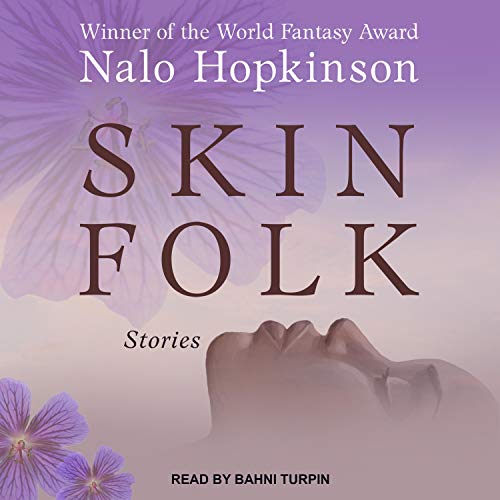
Skin Folk — (2001) Publisher: A new collection of short stories from Hopkinson, including “Greedy Choke Puppy,” which Africana.com called “a cleverly crafted West Indian story featuring the appearance of both the soucouyant (vampire) & lagahoo (werewolf),”"Ganger (Ball Lightning),” praised by the Washington Post Book World as written in “prose [that] is vivid & immediate,” this collection reveals Hopkinson’s breadth & accomplishments as a storyteller.
The Salt Roads — (2003) Publisher: Multiple award-winning author Nalo Hopkinson delivers a triumphant novel in the bestselling tradition of such literary greats as Toni Morrison and Alice Walker.When three Caribbean slave women gather one night to bury a stillborn baby, their collected mournings braid into a powerful calling, and a deity is born. So begins the epic journey of a spirit who, in a desperate bid to discover her own nature and identity, defies the limitations of time and place to inhabit the minds of living women throughout history. From Jeanne Duval, the seductive black mistress of 19th-century bohemian poet Charles Baudelaire, to a Nubian prostitute on a pilgrimage to Jerusalem in 300 A.D., the spirit gathers the power and the wisdom of the ages, only to come full circle on the island of St. Domingue. There, she is reunited with the very women who gave her life, and who still struggle to survive under the tyranny of brutal masters.
Mojo: Conjure Stories — (2003) Publisher: When enslaved people were brought from the western part of Africa to the Americas, they were forbidden to speak their native languages or practice their religions in the New World. But their folkways survived as underground beliefs, and, in the crucible of slavery, created systems of magic and herbal lore with a particularly West African flavor. MOJO draws on the talents of writers who have a reputation for the sensitive, imaginative use of folklore and folkways in their work.
The New Moon’s Arms — (2007) Publisher: What’s in a name? A lot, according to 50-something-year-old Caribbean born Chastity, who has adopted the more fitting moniker Calamity. Now, true to her name, Calamity is confronting two big life transitions: Her beloved father has just died, and she is starting menopause, a physical shift that has rekindled her special gift for finding lost things. Suddenly she is getting hot flashes that seem to forge objects out of thin air. Only this time, the lost item that has washed up on the shore is not her old toy truck or her hairbrush, but a 4-year-old boy. As Calamity takes the child into her care, she discovers that all is not as it seems: the boy’s family is most unusual. Then Calamity must reawaken to the mysteries surrounding her own childhood and the early disappearance of her mother.
The Chaos — (2012) Publisher: An acclaimed fantasy author navigates the world between myth and chaos in this compelling exploration of identity, told with a Caribbean lilt. Sixteen-year-old Scotch struggles to fit in — at home she’s the perfect daughter, at school she’s provocatively sassy, and thanks to her mixed heritage, she doesn’t feel she belongs with the Caribbeans, whites, or blacks. And even more troubling, lately her skin is becoming covered in a sticky black substance that can’t be removed. While trying to cope with this creepiness, she goes out with her brother — and he disappears. A mysterious bubble of light just swallows him up, and Scotch has no idea how to find him. Soon, the Chaos that has claimed her brother affects the city at large, until it seems like everyone is turning into crazy creatures. Scotch needs to get to the bottom of this supernatural situation ASAP before the Chaos consumes everything she’s ever known — and she knows that the black shadowy entity that’s begun trailing her every move is probably not going to help. A blend of fantasy and Caribbean folklore, at its heart this tale is about identity and self acceptance — because only by acknowledging her imperfections can Scotch hope to save her brother.
Sister Mine — (2013) Publisher: As the only one in the family without magic, Makeda has decided to move out on her own and make a life for herself among the claypicken humans. But when her father goes missing, Makeda will have to find her own power — and reconcile with her twin sister, Abby — if she’s to have a hope of saving him… We’d had to be cut free of our mother’s womb. She’d never have been able to push the two-headed sport that was me and Abby out the usual way. Abby and I were fused, you see. Conjoined twins. Abby’s head, torso and left arm protruded from my chest. But here’s the real kicker; Abby had the magic, I didn’t. Far as the Family was concerned, Abby was one of them, though cursed, as I was, with the tragic flaw of mortality. SISTER MINE. Now adults, Makeda and Abby still share their childhood home. The surgery to separate the two girls gave Abby a permanent limp, but left Makeda with what feels like an even worse deformity: no mojo. The daughters of a celestial demigod and a human woman, Makeda and Abby were raised by their magical father, the god of growing things — an unusual childhood that made them extremely close. Ever since Abby’s magical talent began to develop, though, in the form of an unearthly singing voice, the sisters have become increasingly distant. Today, Makeda has decided it’s high time to move out and make her own life among the other nonmagical, claypicken humans — after all, she’s one of them. In Cheerful Rest, a run-down warehouse, Makeda finds exactly what she’s been looking for: a place to get some space from Abby and begin building her own independent life. There’s even a resident band, led by the charismatic (and attractive) building superintendent. But when her father goes missing, Makeda will have to find her own talent–and reconcile with Abby–if she’s to have a hope of saving him…