
More by Harlan Ellison
The Deadly Streets — (1958) Publisher: Remember Charles Bronson stalking the streets of New York blowing holes in muggers in Death Wish? Remember Glenn Ford standing off the vicious juvenile delinquents in Blackboard Jungle? Well, it’s more than fifty years and two different worlds from 1955 to now. And something the author of these stories knows, that you’re scared to admit, is that reality and fantasy have flip-flopped. They have switched places. The stories that scare you today are the ones about rapists and thugs, psychos who’ll carve you for a dollar and hypes who’ll bust your head to get fixed. Glenn Ford’s world was yesterday, and Bronson’s is today. And in the stalking midnight of this book, one of America’s top writers, Harlan Ellison, invades he shadows of both!

Spider Kiss — (1961) Publisher: If you thought the only thing Ellison writes is speculative fiction, craziness about giant cockroaches that attack Detroit or invaders from space who look like pink eggplant and smell like chicken soup, this dynamite novel of the emergent days of rock and roll will turn you around at least three times. No spaceships, no robots, just a nice kid from Louisville with a voice like an angel and an invisible monkey named Success riding him straight to hell…
Gentleman Junkie: And Other Stories of the Hung-Up Generation — (1961) Publisher: This contains: The Children of Nights; Final Shtick; May We Also Speak; Daniel White for the Greater Good; Lady Bug Lady Bug; Free with this Box; There’s One on Every Campus; At the Mountains of Blindness; This is Jackie Spinning; No Game for Children; The Late Great Arnie Draper; High Dice; Enter the Fanatic, Stage Center; Someone is Hungrier; Memory of a Muted Trumpet; Sally in Our Alley; and Gentleman Junkie.
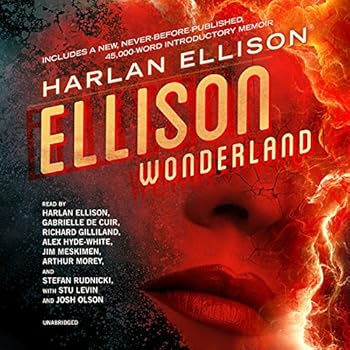
Ellison Wonderland — (1962) aka Earthman, Go Home! Publisher: Ellison Wonderland contains sixteen stories with copyrights ranging from 1956 to 1961. This collection was among Ellison’s first and it shows a writer with a wide-ranging imagination, ferocious creative energy, devastating wit and an eye for the wonderful and terrifying and tragic. Among the gems are “All The Sounds of Fear”, “The Sky is Burning”, “The Very Last Day of a Good Woman” and “In Lonely Lands”. Though they stand tall on their own merits they also point the way to the sublime stories that followed soon after and continue to come even now, more than forty years later.
Paingod and Other Delusions — (1965) Publisher: Perhaps a mooring cable might also be added as necessary equipment for reading these eight wonderful stories: They not only knock you down… they raise you to the stars. Passion is the keynote as you encounter the Harlequin and his nemesis, the dreaded Tictockman, in one of the most reprinted and widely taught stories in the English language; a pyretic who creates fire merely by willing it; the last surgeon in a world of robot physicians; a spaceship filled with hideous mutants rejected by the world that gave them birth. Touching and gentle and shocking stories from an incomparable master of impossible dreams and troubling truths.
I Have No Mouth, and I Must Scream — (1967) Publisher: Harlan Ellison has won more awards for imaginative literature than any other living author, but only aficionados of Ellison’s singular work have been aware of another of his passions… he is a great oral interpreter of his stories. His recordings have been difficult to obtain… by his choice. In 1999, for the first time, he was lured into the studio to record this stunning retrospective. Contents include: an original introduction; I Have No Mouth, and I Must Scream; Laugh Track Grail; “Repent, Harlequin!” said the Ticktockman; The Very Last Day of a Good Woman; The Time of the Eye; Paladin of the Lost Hour; The Lingering Scent of Woodsmoke; and A Boy and His Dog (source of the cult motion picture). This recording is the winner of the International Horror Writers Bram Stoker Award for outstanding non-print media.
From the Land of Fear — (1967) Publisher: A mind bending voyage into the infinite reaches of the imagination. From the Land of Fear: 11 Side Trips to the Dark Edge of Imagination. Eleven tales by master storyteller Harlan Ellison. A look back at stories not included in other collections. In his introduction, the author says: “I would not write them this way were I writing them today. Several of them I find painfully amateurish. Most of the stories were written in the late Fifties. When I was learning my craft.” From the Land of Fear has at least one (or, in fact, two) standout piece, “Soldier,” a clever anti-war tale included both in short-story form and as a screenplay Ellison wrote for TV’s The Outer Limits. 
The Beast That Shouted Love at the Heart of the World — (1969)Publisher: The eleven stories here, first published between 1957 and 1969, can stand up and speak for themselves very well indeed. From the opening shot of the title story to the close with “A boy and his dog” the author delivers a fine selection of his work. 
Over the Edge — (1970) Publisher: A brilliant collection of Harlan Ellison’s short fiction, featuring an introduction by Norman Spinrad. Though blind from birth, Ellison had so developed his other sensory faculties that he was able to distinguish honest citizens from miscreants solely by the odour of the pheromones they exuded.
The Time of the Eye — (1971) Publisher: Here is a collection of dark and wonderful stories by one of the most explosive talents in science fiction today. He has won more Hugo and Nebula Awards — the most coveted trophies of the SF world — than just about any other writer, and, reading these tales of conflict, alienation and future fantasy, it is easy to see why.

Alone Against Tomorrow — (1971) Publisher: Stories of Alienation in Speculative Fiction. This is a 1971 collection of stories from this winner of more awards for imaginative literature than any other living author – including multiple Hugos, Nebulas and Edgars. CONTENTS: Introduction: The Song of the Soul (1970); I Have No Mouth, and I Must Scream (1967); The Discarded (1959); Deeper Than the Darkness (1957); Blind Lightning (1956); All the Sounds of Fear (1962); The Silver Corridor (1956); “Repent, Harlequin!” Said the Ticktockman (1965); Bright Eyes (1965); Are You Listening? (1958); Try a Dull Knife (1968); In Lonely Lands (1959); Eyes of Dust (1959); Nothing for My Noon Meal (1958); O Ye of Little Faith (1968); The Time of the Eye (1959); Life Hutch (1956); The Very Last Day of a Good Woman (1958); Night Vigil (1957); Lonelyache (1964); Pennies, Off a Dead Man’s Eyes (1969).
Approaching Oblivion: Road Signs on the Treadmill Toward Tomorrow — (1974) Publisher: This contains: Introduction: Reaping the Whirlwind; Knox; Cold Friend; Kiss of Fire; Paulie Charmed the Sleeping Woman; I’m Looking for Kadak; Silent in Gehenna; Erotophobia; One Life Furnished in Early Poverty; Ecowareness; Catman; and Hindsight.
Phoenix without Ashes — (1975) With Edward Bryant. Publisher: Written as a collaboration between the multi-Nebula Award winning Ed Bryant and Harlan Ellison, one of the Grand Masters of science fiction and a multiple Hugo-, Nebula-, and Edgar Award-winner, PHOENIX WITHOUT ASHES is the novel edition of Harlan’s famous, award-winning teleplay. The year is 2785, and Devon, a farmer banished for challenging his community’s Elders, discovers a secret that changes everything he knew about the world, leading him on a quest to solve a mystery beyond his understanding before his entire world is destroyed in a cataclysm.
Strange Wine — (1978) Publisher: A remarkable compendium of diverse short fiction by the acclaimed author ranges from satire to horror in such tales as “The New York Review of Birds” and “Working with the Little People” and features such unusual characters as Dr. D’arque Angel who brings death to her patients.
Shatterday — (1980) Publisher: Mercurial, belligerent, passionately in love with language and wild ideas. Harlan Ellison has, for eXactly a quarter of a century, steadily gathered to himself and his thirty-seven books an undeniably fanatical readership. Winner of more awards for imaginative literature than any other living writer, he is the only scenarist ever to win the Writers Guild of America award three times for most outstanding teleplay. Though his contemporary fantasies have been compared favorably with the dark visions of Borges, Barthelme, Poe and Kafka, Ellison resists categorization with a vehemence that alienates critics and reviewers seeking easy pigeonholes for an eXtraordinary writer. The San Francisco Chronicle writes, “The categories are too small to describe Harlan Ellison. Lyric poet, satirist, eXplorer of odd psychological corners, moralist, purveyor of pure horror and black comedy; he is all these and more. In this, his thirty-seventh book, celebrating twenty-five years of setting down the mortal dreads we all share, Harlan Ellison has put together his best work to date: sixteen uncollected stories (half of which are award-winners), totaling a marvel-filled 105,000 words and including a brand-new novella, his longest work in over a dozen years.
Stalking the Nightmare — (1982) Publisher: Pure, 100-proof distillation of Ellison. A righteous verbal high! Here you’ll find twenty of his very best stories and essays (including the four-part “Scenes from the Real World), an anecdotal history of the doomed TV series, The Starlost, he created for NBC; Tales from the Mountains of Madness; and his hilariously brutal reportage on the three most important things in life: sex, violence, and labor relations. With a knockout, an absoloutely killer, Foreword by Stephen King.
The Essential Ellison: A 35 Year Retrospective — (1985) Publisher: In April of 1949, Harlan Ellison was a lonely little kid living in Painesville, Ohio. A time traveler, observing him from within an invisible bubble, would not have marked him as anything more interesting than an undersized fourteen-year-old, seemingly always in hot water. Lively blue eyes, but basically just another kid.” “But something was stirring, something was wakening in that nexus of energy. And in The Cleveland News of June 7th, little more than a week after he turned fifteen, Harlan Ellison’s first professional writing appeared in print: the initial installment of a five-part adventure serial (liberally cribbed from Sir Walter Scott) titled “The Sword of Parmagon.”" “Now, in a retrospective, 50 years of the best of Harlan Ellison has been assembled in a volume exceeding 1200 pages, encompassing fiction, essays, personal reminiscences, reviews and (published for the first time anywhere) a complete teleplay. Eight-six complete and (with one exception) unabridged examples of the nonpareil writings of the man The Los Angeles Times labels “the 20th Century Lewis Carroll.”
Angry Candy — (1988) Publisher: The Seattle Times said of Angry Candy: “Ellison’s stories rattle the bars of complacency that people put around their souls… Razor sharp… piercingly profound.” Once again, Ellison’s writing defies all labels. These seventeen stories by a modern master are an “assembled artifact” of anger and faith — as bittersweet as a”jalapeno-laced cinnamon bear.” The sixteen stories collected here are spread over the farthest stretches of time and space, but even the bleakest of them is warmed by a passionate faith in the endurance of life and its ultimate possibilities. 
Slippage — (1988) Publisher: With this, his best-selling and most critically acclaimed collection ever, Ellison celebrates four decades of brilliant, outrageous writing. The award-winning novella “Mefisto in Onyx” is the centerpiece of an irreverent and wildly imaginative book that the San Diego Union-Tribune called “electrifying… Ellison is back, as unsettling as ever.”
Mind Fields: The Art of Jacek Yerka, the Fiction of Harlan Ellison — (1989) Publisher: Mind Fields was originally conceived as a collection of Jacek Yerka’s paintings, but when Harlan Ellison was approached to write the introduction, he was so overcome that instead he penned a short story for each piece. The result of this synergistic melding of talents, Mind Fields shows two masters at their best. Each of the nearly three dozen stories in this volume is completely unlike any of the others, and together they contain a rich panoply of pathos, humor, and wonder. Produced in a beautiful cloth edition worthy of the art within, Mind Fields is a unique item and a must for any Ellison fan.
The Essential Ellison: A 50 Year Retrospective — (1998) Publisher: Harlan Ellison is probably best known as a script writer for sci-fi and fantasy movies and TV series such as the original Outer Limits, The Hunger, Logan’s Run, and Babylon Five. But his range is much broader than that, encompassing stories, novels, essays, reviews, reminiscences, plays, even fake autobiographies. The Essential Ellison, a special limited edition personally signed and numbered by Ellison, contains 74 unabridged works, including such classics as “A Boy and His Dog,” “Xenogenesis,” and “Mefisto in Onyx.”
Troublemakers — (2001) Publisher: A special new all ages-appropriate collection of Ellison’s short stories, selected especially for this volume by the author himself, featuring a number of stories that haven’t seen print in over thirty years, some newly revised by Ellison.