I, Robot by Isaac Asimov
“..all conflicts are finally evitable. Only the Machines, from now on, are inevitable"
Most science fiction fans know Isaac Asimov’s Three Laws of Robotics:
Robots must not hurt human beings or allow them to come to harm.
Robots must obey human beings so far as it doesn’t violate Law 1.
Robots must not harm themselves as long as this doesn’t violate Laws 1 and 2.
In I, Robot, Asimov presents nine stories within a frame story that explore the implications of these Three Laws of Robotics. The introduction presents the frame story, which introduces Dr. Susan Calvin, who has recently retired from a 50-year career as the world’s first robopsychologist. A reporter is attempting to interview the somewhat reclusive Dr. Calvin, who is reluctant to share her experiences. Through clever flattery, questions and prompts, he finally gets her talking, whic... Read More
Nine Tomorrows: Tales of the Near Future by Isaac Asimov
Isaac Asimov may very well be the most prolific author in modern history. With over 500 books to his credit (506, to be exact... go to asimovonline.com for the full list, if you don't believe me!), covering just about every subject in the Dewey Decimal System (except philosophy, I believe), the man was a real marvel. One of these 500 volumes, Nine Tomorrows, is a collection of short stories that Doc Ike first had published in various magazines during the period July 1956 to November 1958. As the title suggests, all nine tales deal with possible futures that may face mankind, and all feature the wit, erudition and clarity that are the hallmarks of every Asimov story/novel that I've ever read.
The collection kicks off with the longest tale, "Profession," in which Asimov presents a 65th century when one's vocation is determined by a kin... Read More
More science fiction by Isaac Asimov
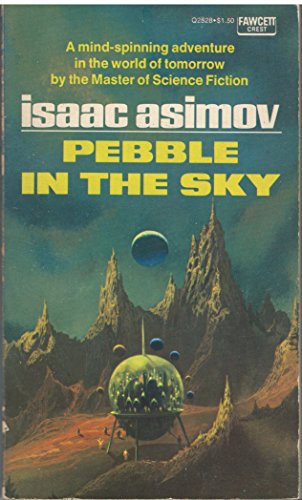
Empire — (1950-1952) One moment Joseph Schwartz is a happily retired tailor in 1949 Chicago. The next he’s a helpless stranger on Earth during the heyday of the first Galactic Empire. Earth, he soon learns, is a backwater, just a pebble in the sky, despised by all the other 200 million planets of the Empire because its people dare to claim it’s the original home of man. And Earth is poor, with great areas of radioactivity ruining much of its soil — so poor that everyone is sentenced to death at the age of sixty. Joseph Schwartz is sixty-two. This is young Isaac Asimov’s first novel, full of wonders and ideas, the book that launched the novels of the Galactic Empire, culminating in the Foundation books and novels. It is also one of that select group of SF adventures that since the early 1950s has hooked generations of teenagers on reading science fiction. This is Golden Age SF at its finest.


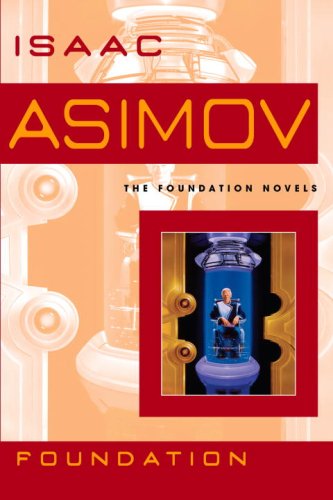
Foundation — (1951-1993) Publisher: When the Galactic Empire began dying, the great psychohist orian Hari Seldon set up the Foundation to preserve human culture & shorten 30,000 yrs. of chaotic barbarism to a mere millennium. Located on a bleak world at the ede of the galaxy, it seemed helpless before the greed of neighboring warlords. But somehow, by science & wit, it had survived & even gained control of a small federation of planets. Yet it was still small. And against it stood the great est power of all — the huge power of the Empire, mighty even in decay. When an ambitious general turned an Imperial fleet toward the Foundation, the only hope lay in the prophecies of Hari Seldon. But even Hari Seldon could not predict the birth & mutant talent of the Mule — one small man w/power greater than a dozen battlefleets. Between big & little, the Foundation seemed doomed.


Lucky Starr — (1952- 1958) Young adult. Publisher: Originally used the pseudonym Paul French. Publisher: David Starr, Space Ranger is the first novel in the Lucky Starr series, six juvenile science fiction novels by Isaac Asimov that originally appeared under the pseudonym Paul French. The novel was written between 10 June and 29 July 1951 and first published by Doubleday & Company in January 1952. Since 1971, reprints have included an introduction by Asimov explaining that advancing knowledge of conditions on Mars have rendered some of the novel’s descriptions of that world inaccurate.


R. Daneel Olivaw — (1954-1985) Publisher: A millennium into the future two advancements have altered the course of human history: the colonization of the galaxy and the creation of the positronic brain. Isaac Asimov’s Robot novels chronicle the unlikely partnership between a New York City detective and a humanoid robot who must learn to work together. Like most people left behind on an over-populated Earth, New York City police detective Elijah Baley had little love for either the arrogant Spacers or their robotic companions. But when a prominent Spacer is murdered under mysterious circumstances, Baley is ordered to the Outer Worlds to help track down the killer. The relationship between Life and his Spacer superiors, who distrusted all Earthmen, was strained from the start. Then he learned that they had assigned him a partner: R. Daneel Olivaw. Worst of all was that the “R” stood for robot–and his positronic partner was made in the image and likeness of the murder victim!


Norby — (1983-1988) With Janet Asimov. Publisher: Norby was originally a robot named the Searcher, created by the robot Mentor First on the planet Jamya. On his initial mission, Norby’s ship crashed in Earth’s asteroid belt and was discovered many years later by a salvager and inventor named McGillicuddy. McGillicuddy welded much of the remaining parts of the Seeker into a steel barrel that originally contained Norb’s Nails, later becoming the basis for Norby’s name. He eventually fell into the possession of a used-robot shop where he was sold to Jefferson Wells, a space cadet looking for a teaching robot. Norby’s body reflects his outer origins as a barrel, while his arms are retractable and have double-sided palms (and two thumbs). His head is round with four eyes, two on each side, and the top is a dome which he can retract into his barrel. His feet are also extendable/retractable. Norby has a tenor voice but can communicate through telepathy by touch. Norby is equipped with a miniature anti-gravity device allowing him to float. He also possesses hyperspace technology, although his choices of locations can be limited to Earth, Jamya, Izz, or somewhere else he has been due to his mixed-up nature. He also has the capability to travel through time via hyperspace. Norby’s many features make him a target for scientists, the army, and the rogue Inventor’s Guild for disassembly and study.


Stand-alone novels:
The End of Eternity — (1955) Publisher: One of Isaac Asimov’s SF masterpieces, this stand-alone novel is a monument of the flowering of SF in the 20th century. It is widely regarded as Asimov’s single best SF novel and one every SF fan should read. Andrew Harlan is an Eternal, a member of the elite of the future. One of the few who live in Eternity, a location outside of place and time, Harlan’s job is to create carefully controlled and enacted Reality Changes. These Changes are small, exactingly calculated shifts in the course of history made for the benefit of humankind. Though each Change has been made for the greater good, there are always costs. During one of his assignments, Harlan meets and falls in love with Noÿs Lambent, a woman who lives in real time and space. Then Harlan learns that Noÿs will cease to exist after the next change, and risks everything to sneak her into Eternity. Unfortunately, they are caught. Harlan’s punishment? His next assignment: kill the woman he loves before the paradox they have created results in the destruction of Eternity.
The Double Planet — (1960) Publisher: Discusses the smallest, most distant, and most mysterious planet in our solar system, its discovery, its peculiar orbit, and its recently discovered satellite.
Fantastic Voyage — (1966) Publisher: Four men and a woman are reduced to a microscopic fraction of their original size, sent in a miniaturized atomic sub through a dying man’s carotid artery to destroy a blood clot in his brain. If they fail, the entire world will be doomed.
The Gods Themselves — (1972) Publisher: Only a few know the terrifying truth — an outcast Earth scientist, a rebellious alien inhabitant of a dying planet, a lunar-born human intuitionist who senses the imminent annihilation of the Sun. They know the truth — but who will listen? They have foreseen the cost of abundant energy — but who will believe? These few beings, human and alien, hold the key to the Earth’s survival.
Destination Brain: Fantastic Voyage II — (1987) Publisher’s Weekly: Twenty-one years ago when the movie Fantastic Voyage was released, Asimov was hired to do the novelization. The book was successful but, to Asimov, not satisfying, for “I never felt it to be entirely mine.” Now he has rewritten it his way, and it’s good. The story concerns Albert Jonas Morrison, a 21st century neurophysicist, and otherwise an ordinary and unheroic man, who is kidnapped and taken to the Soviet Union. A major Soviet scientist, Pyotr Shapirov, is in an irreversible coma, and Morrison’s special expertise could be of value. The Soviets believe that Morrison may be able to apply his controversial theories to retrieve vagrant thoughts that still may be floating in Shapirov’s damaged brain and so provide clues to important work in which Shapirov was engaged. Morrison goes cold with fear because the plan calls for him to be miniaturizedalong with four Soviet scientiststo sub-molecular size, introducing them into Shapirov’s body and, ultimately, into his brain. The snappish relationships between the scientists is wryly depicted, and the mission itself makes fascinating reading as both an actionadventure and an intellectually stimulating premise.
Nemesis — (1989) Publisher: In the twenty-third century pioneers have escaped the crowded earth for life in self-sustaining orbital colonies. One of the colonies, Rotor, has broken away from the solar system to create its own renegade utopia around an unknown red star two light-years from Earth: a star named Nemesis. Now a fifteen-year-old Rotorian girl has learned of the dire threat that nemesis poses to Earth’s people — but she is prevented from warning them. Soon she will realize that Nemesis endangers Rotor as well. And so it will be up to her alone to save both Earth and Rotor as — drawn inexorably by Nemesis, the death star — they hurtle toward certain disaster.
More by Isaac Asimov & Robert Silverberg
Nightfall — (1990) Publisher: These two renowned writers have invented a world not unlike our own — a world on the edge of chaos, torn between the madness of religious fanaticism and the stubborn denial of scientists. Only a handful of people on the planet Lagash are prepared to face the truth — that their six suns are setting all at once for the first time in 2,000 years, signaling the end of civilization!
Child of Time — (1991) Publisher: Based on an Asimov short story, “The Ugly Little Boy”. A children’s nurse is hired as part of a scientific project aimed at bringing a living being from the past to the present. A four-year-old Neanderthal boy is snatched from his home and hurled 40,000 years into a terrifying future.
The Positronic Man — (1992) Publisher: In a twenty-first century Earth where the development of the positronic brain has revolutionized the way of life, beloved household robot “”Andrew”" struggles with his unusual capacity for emotion and dreams of becoming human.
The Ugly Little Boy — (1992) Publisher: Edith Fellowes, the nurse of a Neanderthal ape-boy taken from a primordial past during an experiment in time travel, discovers that the scientists