The Martian Chronicles by Ray Bradbury
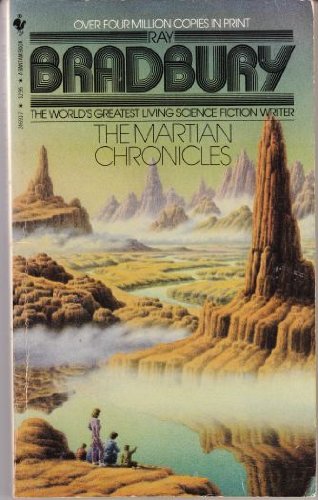
The Martian Chronicles is a collection of Ray Bradbury’s stories about the human colonization of Mars which were previously published in the pulp magazines of the late 1940s. The stories are arranged in chronological order with the dates of the events at the beginning of each story. In the first edition of The Martian Chronicles, published in 1950, the events took place in a future 1999-2027, but a reprinted 1997 edition pushes all events forward to 2030-2057. Because it’s a story collection, The Martian Chronicles has an episodic feel which has been made more fluid by connecting the stories with short vignettes, similar to the structure of Bradbury’s collection The Illustrated Man.
In the first story, “Rocket Summer,” we visit a small town in Ohio while the first human explorator... Read More
Ray Bradbury
(1920-2012)Ray Bradbury is the author of more than three dozen books. He has written for the theater and cinema, including the screenplay for John Huston’s classic adaptation of Moby Dick. He was nominated for an Academy Award, won an Emmy for his teleplay of The Halloween Tree, and adapted sixty-five of his stories for television’s The Ray Bradbury Theater. He lived in Los Angeles before his death on June 5, 2012. Here’s Ray Bradbury’s website.
The Martian Chronicles: Foundational reading
The Illustrated Man: Great Bradbury collection on audio
The Illustrated Man by Ray Bradbury
The Illustrated Man is a collection of Ray Bradbury’s stories which are sandwiched between the account of the titular man whose tattoos come alive at night and set the scenes for the 18 tales in this collection. All of these stories are classic Ray Bradbury — full of spacemen, Earth-Mars conflict, psychiatrists, spoiled children, bad marriages, book burning, domestic work-saving technologies, and nervous breakdowns. They deal with the fear of atomic war, loneliness, prejudice, madness, and the dangers of automobiles, junk food, and media entertainment (but smoking is okay).
All of the tales are written in Bradbury’s incomparable prose and most of them are emotionally touching. But, not surprisingly, they’re almost all grim, making The Illustrated Man a book that you probably won’t want to read all at once unless you want to have you... Read More
Fahrenheit 451: There must be something in books…
Fahrenheit 451 by Ray Bradbury
There must be something in books…
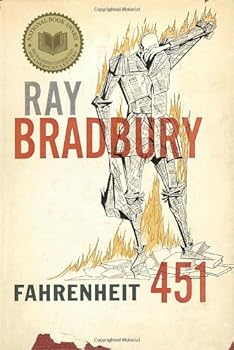
Books are dangerous. They’re full of ideas that make people think about the world, feel passion, and perhaps act out. That’s not good for society; it causes conflict, uprising, and interference with the status quo. People who read and think scare people who don’t, so most citizens have happily given up the right to decide what to think about and now let the government fill their brains with constant loud mindless entertainment. This managed input has equalized society; nobody feels inferior to anyone else and there’s no conflict anymore. Dull minds, constant entertainment, and conformity make society run smoothly.
Guy Montag works as a fireman. He burns books at night while his wife sits in her parlor and listens to inane media shows at high volume. But Clarice, the teenager next door, is different. Her family sits... Read More

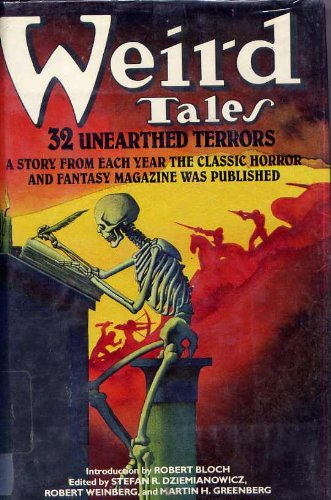
Horrible Monday: Weird Tales: 32 Unearthed Terrors
Weird Tales: 32 Unearthed Terrors edited by Stefan R. Dziemianowicz, Robert Weinberg & Martin Greenberg
Though hardly a runaway success in its day, and a publication that faced financial hardships for much of its existence, the pulp magazine known as Weird Tales is today remembered by fans and collectors alike as one of the most influential and prestigious. Anthologies without number have used stories from its pages, and the roster of authors who got their start therein reads like a "Who's Who" of 20th century horror and fantasy literature. During its 32-year run, from 1923-1954, and in its 279 issues, Weird Tales catered to a select readership that could not help but be impressed by early efforts from the likes of ... Read More
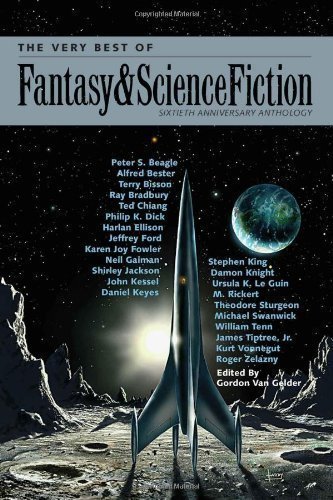
The Very Best of Fantasy & Science Fiction: Sixtieth Anniversary Anthology
The Very Best of Fantasy & Science Fiction: Sixtieth Anniversary Anthology by Gordon Van Gelder (ed.)
The Very Best of Fantasy & Science Fiction: Sixtieth Anniversary Anthology is an excellent collection of 23 stories picked from the treasure trove of short fiction that's been published in the eponymous magazine over the past 60 years. Editor Gordon Van Gelder — also the editor of the magazine since 1997 — has done an admirable job, picking stories that illustrate the diversity of both the genre and the magazine. As such, this is a great anthology for SF&F fans as well as newcomers looking for a taste.
The line-up of authors in this collection looks like a veritable Who's Who of speculative fiction: Ray Bradbury, Read More

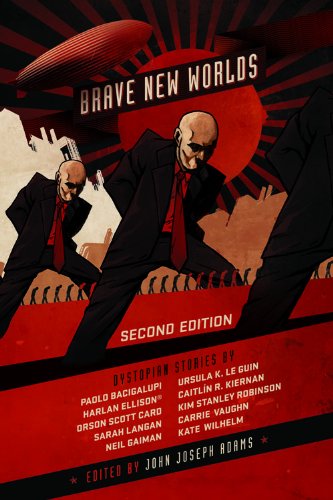
Brave New Worlds: Dystopian Stories
Brave New Worlds: Dystopian Stories edited by John Joseph Adams
Even people who don’t usually read science fiction will often be familiar with a few classic titles in the “dystopian SF” sub-genre. After all, 1984, Fahrenheit 451, and of course the famous Aldous Huxley novel Brave New World are some of the few SF titles that have entered the mainstream literary canon to such an extent that they’ve become assigned school reading for many students. However, novel-length dystopian SF didn’t stop with those venerable classics, and can even be said to be thriving at the moment. See, for example, the recent success of Paolo Bacigalupi’s debut The Windup Girl Read More
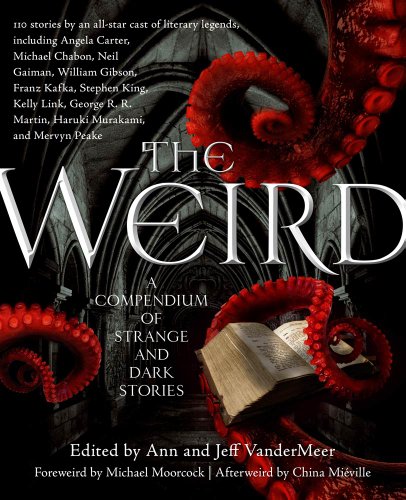
The Weird: A Compendium of Strange and Dark Stories
The Weird: A Compendium of Strange and Dark Stories edited by Ann and Jeff VanderMeer
I haven’t actually read every page of The Weird: A Compendium of Strange and Dark Stories, yet I’m giving it my highest recommendation. Edited by Ann and Jeff VanderMeer, Master and Mistress of Weird, The Weird is 1126 pages long and should really be considered a textbook of weird fiction. It contains 110 carefully chosen stories spanning more than 100 years of weird fiction. Here’s what you can expect to find in this massive volume:
A “Forweird” by Michael Moorcock gives us a brief history of the weird tale, discusses how it has defied publishers’ attempts to categorize it into neatly-bordered genres, and gives examples of writers who are revered by modern readers but whose weird fiction caused them to be... Read More
Brave New Worlds: Second edition of an excellent anthology of dystopian fiction
Brave New Worlds (second edition) edited by John Joseph Adams
This anthology of dystopian fiction, edited by John Joseph Adams, contains stories from some of the greatest names in fantasy and science fiction, including Ursula K. LeGuin, Paolo Bacigalupi, Cory Doctorow and Kim Stanley Robinson. The first edition was reviewed by Stefan Raets and earned a five-star rating. I picked up the second edition to see what the new volume added.
What I found was that the entire first edition was intact. Three stories were added, along with a study guide featuring questions for some of the stories if you wanted to use this in a book club (I w... Read More
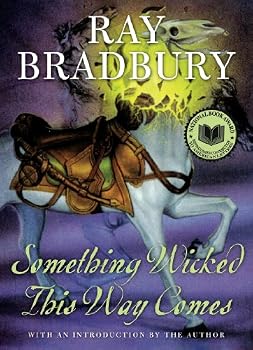
Something Wicked this Way Comes — (1962) Publisher: An old woman becomes young again and a man regains his severed leg. Two boys watch as strange things happen when a carnival comes to town. They will soon discover the show’s awful mystery. It is a mystery that will alter the life of everyone it touches.
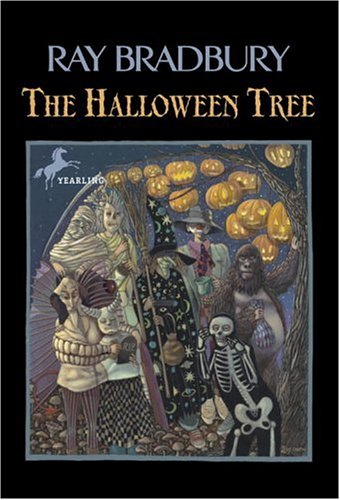
The Halloween Tree — (1972) Publisher: A thousand pumpkin smiles look down from the Halloween Tree, and twice-times-a-thousand fresh-cut eyes glare and wink and blink, as Carapace Clavicle Moundshroud leads the nine children on a leaf-tossed, kite-flying, gliding, broomstick-riding trip to learn the secret of All Hallow’s Eve.
Death Is a Lonely Business — (1985) Publisher: Ray Bradbury, the undisputed Dean of American storytelling, dips his accomplished pen into the cryptic inkwell of noir and creates a stylish and slightly fantastical tale of mayhem and murder set among the shadows and the murky canals of Venice, California, in the early 1950s. Toiling away amid the looming palm trees and decaying bungalows, a struggling young writer (who bears a resemblance to the author) spins fantastic stories from his fertile imagination upon his clacking typewriter. Trying not to miss his girlfriend (away studying in Mexico), the nameless writer steadily crafts his literary effort-until strange things begin happening around him. Starting with a series of peculiar phone calls, the writer then finds clumps of seaweed on his doorstep. But as the incidents escalate, his friends fall victim to a series of mysterious accidents-some of them fatal. Aided by Elmo Crumley, a savvy, street-smart detective, and a reclusive actress of yesteryear with an intense hunger for life, the wordsmith sets out to find the connection between the bizarre events, and in doing so, uncovers the truth about his own creative abilities.
Bradbury Classic Stories 1: From the Golden Apples of the Sun and R Is for Rocket — (1990) Publisher: These strange and wonderful tales of beauty and terror will transport the reader from the light to the dark, from inner space to the infinite, from the beginnings of time to the outermost limits of the future.
A Graveyard for Lunatics: Another Tale of Two Cities — (1990) Publisher: Halloween Night, 1954. A young, film-obsessed scriptwriter has just been hired at one of the great studios. An anonymous investigation leads from the giant Maximus Films backlot to an eerie graveyard separated from the studio by a single wall. There he makes a terrifying discovery that thrusts him into a maelstrom of intrigue and mystery — and into the dizzy exhilaration of the movie industry at the height of its glittering power.
Ahmed and the Oblivion Machines: A Fable — (1998) Publisher: Lost in the desert, young Ahmed awakens the ancient god Gonn-Ben-Allah with his cries of despair and is granted the gift of flight, which he uses to travel with the god on a series of adventures through time and space.
From the Dust Returned: A Family Remembrance — (1999) Publisher: In a strange old house, the Elliot family, which includes mind-readers, vampires and many others, gradually come together, mixing their arcane skills and life-styles, falling in and out of love and changing the world around them forever.
Bradbury Stories: 100 of His Finest Tales — (2003) Publisher: Encapsulating a career that has spanned more than six decades, this retrospective compilation confirms what everyone already knows: Ray Bradbury is the master of short fiction. Included in this “collection to end collections” are classics like “The Illustrated Man,” “The Toynbee Convector,” and “The Pedestrian” (the precursor to Fahrenheit 451), as well as little-known literary gems like “Almost the End of the World,” a story about what happens when humanity loses television reception; “The Garbage Collector,” Bradbury’s reaction to an ignorant politician; and a bittersweet story (“Bug”) about an aging man who lets reality get between him and the thing he loves most.

Now and Forever: Somewhere a Band Is Playing & Leviathan ’99 — (2007) Publisher: Two never-before-published novellas by one of America’s finest living writers, Ray Bradbury. A journalist bearing terrible news leaps from a still-moving train into a small town of wonderful, impossible secrets… The doomed crew of a starship follow their blind, mad captain on a quest into deepest space to joust with destiny, eternity, and God Himself… Now and Forever is a bold new work from an incomparable artist whose stories have reshaped America’s literary landscape; two bewitching novellas that have never before appeared in print — each distinctly different, yet uniquely Bradbury — demonstrating the breathtaking range of the master’s talent and the irrepressible vitality of his mind, spirit, and heart. In Somewhere a Band Is Playing, a writer is drawn by poetry and dreams to tiny Summerton, Arizona, a community hidden in plain view, where no small children play, and where the residents never seem to age. Enchanted by its powerful rural magic — and by a beautiful, enigmatic lady who bears the name of an Egyptian queen — the writer sets out to uncover Summerton’s mysteries before the inevitable arrival of a ruthless destruction. With Leviathan ’99, the author who once colonized Mars returns to the cosmos to brilliantly reimagine Herman Melville’s classic masterwork of obsession and the sea, transforming a great whale into a worlds-devouring comet. In the year 2099, fledgling astronaut Ishmael Hunnicut Jones boards the Cetus 7, placing his fate in the hands of a relentless madman who is blindly chasing the celestial monster’s tail. And in the merciless void, a crew of earthborn and alien star-travelers will face a divine judgment, and an “enemy” wielding the most fearsome weapon of all… Time. More than a half century into his remarkable career, Ray Bradbury continues to delight and astound with grand visions, lyrical prose, and provocative thought. Rich in poetry, wonder, imagination, and truth, here is proof positive that the words and stories of the inimitable Bradbury will live on… Now and Forever.
Summer Morning, Summer Night —(2008) Publisher: Green Town, Illinois stands at the very heart of Ray Bradbury Country. A lovingly re-imagined version of the author’s native Waukegan, it has served as the setting for such modern classics as Dandelion Wine, Something Wicked This Way Comes, and Farewell Summer. In Summer Morning, Summer Night, Bradbury returns to this signature locale with a generous new collection of twenty-seven stories and vignettes, seventeen of which have never been published before. Together, they illuminate some of Green Town’s previously hidden corners, and reaffirm Bradbury’s position as the undisputed master of a unique fictional universe. In the course of this volume, readers will encounter a gallery of characters brought vividly to life by that indefinable Bradbury magic. Included among them are a pair of elderly sisters whose love potion carries an unexpected consequence; a lonely teacher who discovers love on Green Town’s nocturnal streets; a ten-year-old girl who literally unearths the intended victim of a vicious crime; and an aging man who recreates his past with the aid of a loaf of pumpernickel bread. Each of these stories is engaging, evocative, and deeply felt. Each reflects the characteristic virtues that have always marked the best of Bradbury’s fiction: optimism, unabashed nostalgia, openness to experience, and, most centrally, an abiding generosity of spirit. Summer Morning, Summer Night is both an unexpected gift and a treasure trove of Story. Its people, places, images, and events will linger in the reader’s mind for many years to come.
Magazine Monday: Weird Tales No. 360
The owner, publisher and editor of Weird Tales have all changed since the last issue of the magazine, and it shows. No longer innovative, with cutting edge fiction, it is now filled with pastiches of the work of H.P. Lovecraft, a throwback to the early days of the magazine. The Hugo-Award-winning team of fiction editor Ann VanderMeer and editorial and creative director Stephen H. Segal are clearly no longer choosing the fiction or art that used to brighten each issue, and the intelligent nonfiction that completed the magazine is nearly gone, though Kenneth Hite’s exploration of Lovecraft’s work, “Lost in Lovecraft,” continues; the fourteenth entry in the series is in this issue. This change is not for the b... Read More


The Bone Key: Tales of weirdness and horror