
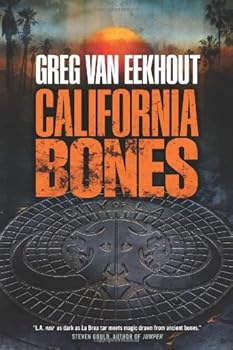
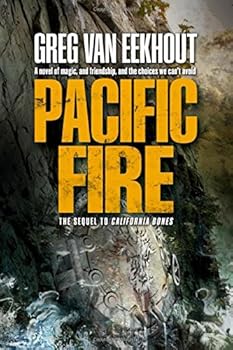
Greg van Eekhout’s California Bones generated a lot of excitement when it came out last year. Now that the sequel, Pacific Fire, is out, Van Eekhout is doing a “mini book tour.” He stopped in Petaluma, California, at Copperfield’s Books, to talk with horror editor Ross E. Lockhart about the trilogy, writing for adults versus middle graders, his love of the band Rush and his opinion about the need for a Black Widow movie. I was in the audience and made a few notes from their dialogue. I also picked up a couple of signed books to give away to one of our readers. Comment on this post to be entered to win a signed copy of both California Bones and Pacific Fire.

Greg van Eekhout (left) chats with Ross E. Lockhart at Copperfield’s Books in Petaluma, CA
Since California Bones and the OSTEOMANCY TRILOGY grew out of a short story, van Eekhout talked about his own transition from successful short story writer to novelist.
“I thought I would always be happy writing short fiction, working in 2,000-5,000 word increments. My favorite writers are short fiction writers; Ray Bradbury wrote some novels but his best work is his short stories. All my friends and peers were writing, selling and publishing novels, so I felt left out. After I wrote one, I said to myself, ‘I will never give up short fiction, it’s the purest expression of the art, etc, etc,’ and now I almost never write short fiction.” He will, however, have an invitational short story in an anthology based on songs by Rush, because, “I’m kind of a Rush nerd.”
 Van Eekhout is currently completing final revisions to the third book in the OSTEOMANCY series, Dragon Coast, which is due out in September, 2015. Lockhart asked him if Tor was a house that engaged in heavy editing or light editing. “They are light editors. My editor’s philosophy is that a flawed book that is the writer’s vision is better than a perfect book that is not your vision.”
He said he didn’t intend for his story, “The Osteomancer’s Son” to evolve into a novel, but book editors asked him about it. When he completed the book and sent it to Tor, Patrick Neilsen Hayden asked him if it was a trilogy.
“And I said, ‘It’s totally going to be a trilogy.’ I decided the next book would be about Daniel [Blackland’s] daughter, you know, like ‘The Osteomancer’s Granddaughter’ and Hayden said, ‘Daniel’s going to be a strong character throughout the trilogy, right?’ I said, ‘He’s totally going to be a strong character throughout!’”
California Bones takes place in an altered Los Angeles. Lockhart and van Eekhout discussed world-building. Van Eekhout did not want a “one thing different” world; “You know, like it’s this world only there’s vampires.” He imagined a magical force based on eating bones of magical animals (the eater absorbs the magical power of the creature). From this he evolved a landscape that does not look like modern 21st century USA. As a secondary magical system, he uses water. “To me, the biggest landmark of LA is the freeways, and I wanted to change that, so that’s how I got the canals.”
 After Dragon Coast, van Eekhout said his next book will also be for adults rather than middle-graders. “Now that I’ve written a trilogy, I’m hungry to write a standalone. It’s difficult because as you know, trilogies are a commercial unit now. They’re like, the ‘unit of book.’ It’s the same way with movies. ‘Franchise’ is the unit of movie. And that’s why we don’t have a Black Widow movie! The studios are afraid they can’t sign Scarlett Johannson for that many movies… so instead we get Antman!” He paused. “I have strong feelings about this.”
He and Hartman talked a lot about the books and the characters, and I’m not going to include much else here because there were spoilers.
Lockhart has edited several high caliber horror anthologies including The Book of Cthulhu. He was thoughtful and well-prepared, and the “interview” was very relaxed. Because the two are friends, that relaxation did lead to more revelations about California Bones and Pacific Fire than strictly necessary, but it moved me along on the reading scale from “I’ll read it someday” to “must read soon,” so that wasn’t a bad thing. Greg van Eekhout comes across as an open, friendly, wildly imaginative guy, and that’s what I like to see in my fantasy writers. I was thrilled to find out he visits Fantasy Literature and likes the site! The feeling’s mutual, Greg.
Readers, don’t forget to comment on this post to enter to win a signed copy of both California Bones and Pacific Fire.


I read an excerpt of California Bones. It was terrific. Been meaning to pick it up. thanks.
I like the sound of these books. Thanks for the interesting interview, Marion!
Great column, Marion! Wish I’d been there.
And I agree with the “must read soon” conclusion, btw. I thought California Bones was pretty great, and can’t wait to dig into Pacific Fire.
Have heard a lot of good things about both books. Wouldn’t mind at all winning them.
I’ve heard so many good things about these books. Thanks for offering the chance to win them!
I’ve wanted to read these books!
Interesting article! Been meaning to read them but haven’t gotten the chance yet. Thanks for the chance to win the books!
Can’t wait to pick these up! Sounds like a great read.
Long live the short story!!!!
Wish I had been able to see Greg on his west coast book tour. Curious what unnecessary revelations were made during this discussion!
Mark, they probably weren’t unnecessary for those who had read the first book. They talked a lot about various characters, for instance. I’ve probably said enough.
Hooray!
I’ve heard a lot about these books and they sound exciting.
I’ve heard such great things about these books! I can’t wait to read them :)
These books sound awesome. I’d love to win!
Great interview, been wanting to pick these up, would love to win them!
Nice article and both books look like they will be fun reads!
Michael Healy, if you live in the USA, you win signed copies of CALIFORNIA BONES and PACIFIC FIRE.
Please contact me (Marion) with your US address and I’ll have the book sent right away. Happy reading!