
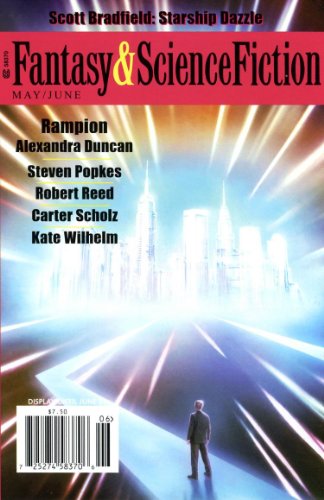
 The May/June issue of Fantasy & Science Fiction is bookended with stories about music by two stalwarts of the field, Chet Williamson and Kate Wilhelm. Both demonstrate that they still wield a strong pen; both tales are excellent.
Chet Williamson’s “The Final Verse” is about two men who set out to find the final verses to a folk song called “Mother Come Quickly.” It’s supposed to be one of the best-known songs in popular music, performed by just about everyone of note, but it has its origins in Appalachia, and those origins are foggy. The structure of the song indicates that something’s missing; the last verse has only four lines, while all the other verses have eight. Pete Waitkus, the grandson of the man who first discovered the song, thinks that he knows how to discover the missing lines, because he’s listened to an old recording of his grandfather discussing the song with an old mountain woman. There’s information there, Pete thinks, that his grandfather overlooked. And so he looks up his buddy, Billy Lincoln,who narrates the story, and asks him to come along on an Appalachian outing to find the family the song is about and get them to reveal the missing verse. Billy’s a more or less washed-up bluegrass and country musician who sees in this a chance to get his name back into the limelight, so he goes along. Off the two go in Pete’s nice RV, over rutted roads and down tree-blocked roads.
Billy and Pete find an old mansion “where the two creeks meet,” as the song goes, and conclude that it’s the right place. But it’s the dark of night when they get there, so they make dinner and crawl into bed. Or at least Billy does; Pete apparently can’t sleep, because the next thing Pete knows he hears some terrible yowling that it takes him some time to decipher as human singing. Billy crawls out of the RV and discovers Pete talking to an old, old woman with whom he seems surprisingly enthralled – enthralled not by what she’s saying (which is interesting enough, since it’s about the song), but by the woman herself, whom he inexplicably seems to find as sexy as can be. And this is where the wheels come off the bus — or the RV, if you will — and things start to get seriously weird. There’s magic up in those hills, and it’s not all the white kind, either. But there’s an escape, and just when we think things might go well for Billy, Williamson gives us reason to seriously doubt it. It’s a beautifully constructed story, easily the best in this issue.
Wilhelm’s story is gentler, a tale of a jazzman and his lover who have died but still somehow seem to inhabit the beautiful southern home they inherited in Memphis. The musical legacy of the two infects new generations and lingers on its own as well. This isn’t a story in which plot matters much; it’s the milieu that Wilhelm evokes that stays in one’s mind long after the last page is turned. There are some problems with the story that are surprising from a pro like Wilhelm — for instance, the point of view changes from one character to another and back again without warning or reason — but it’s a pleasant story.
The novella “Rampion,” by Alexandra Duncan, might confuse you if you don’t know the fairy tale on which it is based – I didn’t, and don’t, and therefore didn’t quite understand why this story of a blind man in Cordoba, Spain, during the time of the Umayyad Moors is in a fantasy and science fiction magazine; it seems to be purely romantic historical fiction. One character is rumored to be a witch, but there’s no evidence of it, no magic in the story, nothing that suggests fantastic occurrence. The story is a straightforward tale of a Moor who seduces a Christian woman in a time when women weren’t allowed to make their own choices. He pays a heavy price for it, but finds a way out of his troubles. Much as I’ve enjoyed the tales set in Muslim countries and with Arabian themes that seem to be regularly popping up lately, I found Duncan’s story flat and insufficiently detailed to truly establish a faraway time and place.
There’s an intriguing pair of stories from Robert Reed. The first, “Stock Photos,” left me entirely mystified. It has to do with a man out mowing his lawn when a man and a woman drive up and ask to take his photograph as stock footage. They goad the man into other poses and activities for further photographs until finally they have him posing with a Belgian assault rifle, and things start to snap into place, just a little — but not enough. It is only when you read the follow-up, “The Road Ahead,” that things start to make sense. Very clever work.
“Altogether Elsewhere, Vast Herds of Reindeer” by Ken Liu is an unusual story of what happens after we all become nothing but a bunch of zeros and ones, totally digitized — life after the Singularity. As tempting as essentially eternal life might seem, would it really be an altogether good thing to give up the exploration of anything but inner space? Or are we meant to go to the stars? Profound questions are posed in this short but thought-provoking story.
“The Black Mountain” by Albert E. Cowdrey is about the attempt to preserve the only beautiful part of a truly ugly building, and what is discovered in undertaking that effort. “Signs of Life” by Carter Scholz features a gene sequencing project in which some interesting patterns are discovered in junk DNA, which comprises a surprising amount of the human genome. “The Old Terrologist’s Tale” by S.L. Gilbow seems to be trying to say something about how danger and beauty are inextricably linked in a planet’s geography, but it’s not clear whether the lesson is that we should terraform worlds so as to eliminate beauty in order to eliminate danger.
“Agent of Change” by Steve Popkes is about Godzilla — no, really, it’s about Godzilla. “Fine Green Dust,” by Don Webb, is also about lizards. It must be something in the overheated air that is making these authors see green. Scott Bradfield’s “Starship Dazzle” is a third story intended to be humorous, though this time the animal involved is a dog and not a lizard. All three remind the reader that comedy is difficult; none of them works well.
The one bit of writing in this issue that truly did make me smile was Paul Di Filippo’s recurring feature, “Plumage from Pegasus.” This entry in the series, entitled “Building a Readership,” is about a writer who purchases a Lector-5000, a robot produced by — of course! — Apple, and intended to be a companion to readers, able to discuss books, recommend new reading material, and generally be a reader’s best friend. Here the reader-purchaser also happens to be a writer, and he makes the fatal mistake of asking the electronic gadget to read and comment on his work. That might sound bad enough, but he makes an even more classic mistake before he gets this far. Fortunately, that mistake can be corrected, and it takes care of everything else.
Gordon Van Gelder’s editorial about F. Gwynplaine MacIntyre is touching and sad, the finest of the features — book reviews, movie reviews and a nonfiction piece about a past F&SF editor — that round out this edition.


I may be able to solve the rampion mystery–it’s a variant on Rapunzel, and the guy in that ends up blinded for a while, and I can see the “locked in a tower” motif in what you describe.
Hurraay! Magazine Monday is back!