
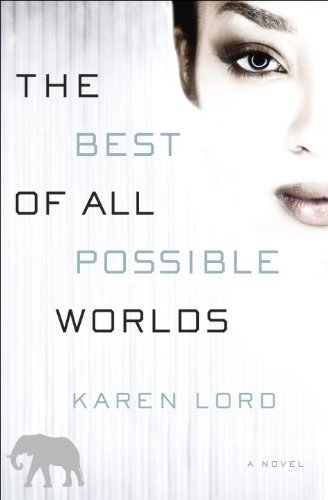
 The Best of All Possible Worlds by Karen Lord
I have to confess that I spent at least the first third of Karen Lord’s The Best of All Possible Worlds mostly annoyed and disappointed by the writing. I found the writing flat, the world-building slim, and the character relationships implausible, simplistic, and melodramatic. But around halfway through, the book, despite its flaws, started to grow on me somewhat and by the halfway point I was mostly in, though I still had some major issues.
The setting is a far-future in a universe populated by different types of humans, including Terrans, Sadiri, and Zhinuvians, each with varying degrees and types of psionic powers, such as telepathy or emotional “broadcasting.” When the Sadiri home planet is destroyed, one group settles on Cygnus Beta and begins a search for “Cygnians with a high percentage of taSadiri genetic heritage.” The main character, a Cygnian biotechnician named Grace Delarua, is assigned to liaison with the Sadiri exploratory team, led by Dllenahkh and made up of a handful of other Sadiri, including a married couple and a younger Sadari male on the lookout for a possible mate. The book is mostly episodic at first, with the group heading off to one provincial settlement after another, and then it becomes more focused on the group’s interior dynamics, Delarua’s family dynamics, and a bit more on what happened to the Sadiri planet.
I’ll begin with the flaws as they drove so much of the reading for me, especially at the start. The world-building, as I said, I found pretty slim. We’re given a bare-bones explanation of this universe with very little detail. The same is true on a smaller level with the planet and on a smaller level with the various settlements. This last one was perhaps the most disappointing as I was hoping to get much more in those areas, a la an Ursula LeGuin kind of anthropological look (would have loved to have seen what she would have done with this concept), and while there were moments, there just wasn’t enough consistent depth for me. Even on a sentence/paragraph level I found myself often wishing for at least a little more physical detail or concrete imagery; most of the book is conveyed via dialogue and internal monologue. Finally, though on a more trivial note, I found myself distracted by some of the details we were given. In particular the several references to “classic” movies and film which felt a little forced in terms of the humor and a bit implausible in terms of their surviving into this future (though I did like the Bradbury reference, I admit).
The main character, Delarua, as I said, did grow on me by the end. But at the start she really bugged me. Her character was too superficial, too immature-sounding for much of the start. In fact, there were several times with her and other female characters where the portrayal of the women felt uncomfortably over-emotional and “middle-schoolish.” It didn’t help that the romantic angle was pretty obvious from the start and all went pretty predictably, though I give Lord credit for not rushing it. Dllenahkh fared somewhat better, especially as the book progressed and he became more fleshed out as a character with some added depth and nuance. The side characters are weaker: the young Sadiri is pretty one-note, in fact I’d have to say most are. And some characters fly in and out to little impact. Even the ones that do have a narrative impact are very flat and two-dimensional.
Finally, I didn’t much care for the novel’s episodic structure, though that probably had a lot to do with the above issues. I supposed had the characterization been stronger and the details more vivid, I might have had fewer issues with the movement from one place to another, but as it was, save for a few scenes, I didn’t feel like we spent enough time in each episode to have much of an impact, nor did I feel they were strongly enough linked.
So what happened to make the reading more enjoyable? Well, first of all, the main character seemed to drop a lot of the overly wrought emotions (not fully, but enough) and immaturity. Dllenahkh became much more complex of a character. Their growing relationship, while predictable from the start, was handled in a touching and subtle fashion for the most part. There was also more exploration of the effect of Sadiri’s destruction. There’d been some glimpses of the emotional depth such an event could evoke, but it felt like the potential was more fully plumbed later in the book. Also, the plot seemed to become more focused rather than leaping from one somewhat disconnected event/place to another (to be fair, there are thematic connections between these seemingly disparate episodes).
I did end up enjoying The Best of All Possible Worlds more than not, though I can’t say the flaws ever faded fully into the background. I give it a qualified recommendation, with a real wish I could have given it more. Great concept, but unfortunately the execution doesn’t match the idea.
~Bill Capossere
 The Best of All Possible Worlds is Karen Lord’s second published novel, after her 2010 award-winning debut Redemption in Indigo. I haven’t had the chance to read that first novel yet, but it’s definitely on my list after reading her second effort. The Best of All Possible Worlds is a thought-provoking novel that hides a surprising amount of depth under a deceptively cheerful narrative. It’s not perfect, but it’s so brimming with interesting concepts that it practically begs for in-depth discussion.
The novel starts off with a shock: while on an off-planet retreat, a Sadiri man is informed that the entire population of his home planet has been killed in a horrific attack. We leave the scene right after he hears the news, when he understandably enters into a numbing state of shock.
The next chapter starts with the sentence: “I remember when the Sadiri came,” setting the tone for the majority of the rest of the novel. The surviving Sadiri (mostly those who were off-planet, such as Dllenahkh from the first chapter) have decided to try and replenish their almost extinct race by tracking down the “taSadiri,” who are basically the descendants of Sadiri who left home for one reason or another and settled on other planets. One of these planets, Cygnus Beta, is a frontier-like “live and let live” place where a variety of populations with varying philosophies and levels of technological development have settled homesteads and spread out. The remaining Sadiri hope that, even given the vast amount of time that’s passed since these settlements started, some of them will still carry sufficient Sadiri genetic traits.
The largest part of the novel deals with a joint mission of Sadiri representatives and Cygnus Beta government officials to various settlements that may or may not be a good source for, well, let’s be honest, Sadiri brides. As rational and considerate and highly evolved as the Sadiri are, they’re essentially looking for breeding stock to get their race back up to critical mass. They’re as delicate and tactful and careful to avoid insult as could be, but still, it is what it is.
The Sadiri are presented throughout the novel as the most rational and self-controlled race in a universe that houses several other human variants. They have a form of telepathy, which is the direct source of several plot threads throughout the novel. Before their downfall, the Sadiri were looked up to as the most enlightened race in the universe, using their fleet and advanced intellect to settle disputes. “How the mighty have fallen” is a recurring thread throughout the novel. Even before Karen Lord makes it obvious (in one of the oddest sections of the novel), the parallels with elves in fantasy are easy to draw.
The vast majority of The Best of All Possible Worlds is narrated by Grace Delarua, a minor functionary on Cygnus Beta who happens to have some Ntshune blood, which gives her strong empathic skills — as opposed to the Sadiri telepathy. Delarua accompanies the Sadiri mission as it sets out to look for compatible taSadiri settlements. From early on it becomes quite clear that there’s some romantic tension between Delarua and Dllenakh, as different as they may be. This sets up an ongoing and somewhat over-emphasized contrast of “the head and the heart” between the two characters’ abilities and personalities. Think Spock and Kirk (the Sadiri often sound exactly like Vulcans) or for a more recent example, the contrast between Swan and Wahram in Kim Stanley Robinson’s excellent 2312.
One of the strange consequences of having the generally upbeat Delarua narrate all but a few short sections of this story is that it gives the book an oddly cheerful tone, especially for a novel that’s dealing with the aftermath of a planetary genocide. Delarua self-describes as having a “sunny disposition,” and seeing everything from her happy-go-lucky perspective (not to mention following the developing love story), it’s easy to get lulled into a sense of comfort and forget the shadow hovering over everything.
Because of this, The Best of All Possible Worlds is a bit deceptive: it’s smoothly narrated, consistently entertaining, and often even funny (Karen Lord has great comedic timing), but because we’re seeing everything through the relatively narrow perspective of Delarua, it takes some reading between the lines to unpeel all of this story’s layers. This is a short novel you can read through in a few hours, possibly missing the thematic richness and the real drama that’s filtered through Delarua’s chipper personality. Colonialism, race, gender roles and sexual identity, bio-ethics, psychological and emotional abuse, and personal liberty versus the public good are all themes that are explored, some out in the open and in-depth, most of them more implicitly.
Another layer that adds to this complexity is Karen Lord’s frequent variations on the unreliable narrator. Delarua’s memory is affected on several occasions. The mental disciplines of the Sadiri themselves can affect people’s perceptions and memories. Other instances are caused by chemicals or by other characters. Some of them are voluntary, some are not. Some are later repaired, others aren’t. Again, some of this is easy to read over thanks to Delarua’s demeanor, but in the end it’s clear that, out of all the characters, she is often the least reliable person to interpret the novel’s events.
In that sense, The Best of All Possible Worlds shares some qualities with Ursula K. Le Guin’s Hainish series and especially with C.J. Cherryh’s novels, specifically the limited perspective on larger events, the implied complexity and history of the fictional universe, and the focus on anthropology and sociology. However, the general tone of the novel is as different from Cherryh as could be, mainly because the prose is much less dense. Karen Lord also reaches out a hand to her readers by telling several short sections from Dllenahkh’s perspective, which is another big reason why this novel is so much more accessible than the average Cherryh. Imagine the level of gravitas this story would have had if it had been written entirely from the point of view of one of the Sadiri characters.
The main aspect of this novel that didn’t work for me is its structure. Once Karen Lord has set up the basic starting positions of the story, the book turns into an episodic novel: now we’re going to visit this settlement, and here’s what happens there, and now we’re going to this settlement, and this is how we solve that situation, and so on. The book becomes a connected set of smaller events, almost like an old-fashioned planetary adventure complete with highly noticeable seams. (It’s possible that this was done on purpose, as a commentary on some of that genre’s more old-fashioned tropes, some of which are strongly called into question here. However, that’s probably pushing this interpretation way too far.)
Most of the episodes are interesting and very different from each other, plus there are connecting threads and character arcs that continue throughout, but overall the novel’s structure affects its narrative tension in a less than positive way, especially in its middle section. This is then exacerbated by the ending, which is somewhat of an anti-climax when compared to the novel’s explosive starting point. The Best of All Possible Worlds is a novel that’s rich in content, but it meanders rather than builds, and settles with a gentle sigh rather than a big climactic resolution.
That richness of content is also at odds with the novel’s length. This is a relatively short book, when compared to the incredible amount of subplots and character dynamics Karen Lord has jammed into it. Multiple races, several mini-civilizations on Cygnus Beta, at least four romances at varying levels of development, one huge family drama, several personal traumas, some surprising scientific developments, plenty of moral dilemmas, numerous vague and more explicit hints at the universe’s history… it just keeps coming. Much of this is only hinted at or mentioned briefly, maybe because it happens in the periphery of Delarua’s vision. This gives the novel an oddly empty feeling, despite being so full of ideas. I would have gladly read a novel twice the length, if it would have allowed Karen Lord to stop and develop some of these elements in more detail.
Still, there’s much to like here. The Best of All Possible Worlds is almost the perfect selection for a book discussion group, because it’s so chock-full of concepts, themes and characters of various plumage. There’s so much fodder for contemplation here, so many hooks for people to grab onto and dig deeper. It also offers a fictional universe that clearly will allow much more exploration and development in future novels or stories, something I’ll definitely look forward to. So, don’t be caught off-guard by Delarua’s cheerfully direct narration, take your time and look for the deeper currents hiding in this novel. If you do, you’ll end up contemplating The Best of All Possible Worlds long after you finish reading it.
One final note: if the person on the U.S. cover is supposed to be Grace Delarua, she’s portrayed with a completely different skin tone than the “cedar brown” she’s described with in the story. Make of that what you will; I personally find it extremely disappointing.
~Stefan Raets


I’ve been looking forward to reading this one for a while, and I’m definitely interested to see how the worldbuilding and culturebuilding holds up in my mind compared to the reviews I’ve read for it. From everything I’ve been seeing, it looks like it’ll hold up well to my expectations, but we shall see. Excellent review, and I’m looking forward to reading it even more now!