
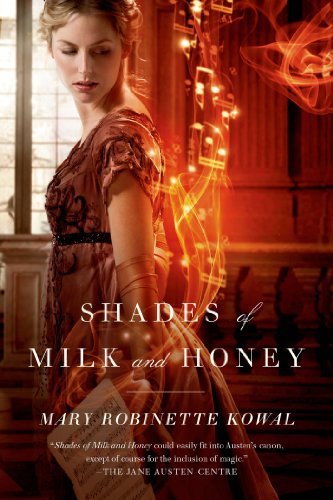
 Shades of Milk and Honey by Mary Robinette Kowal
Jane Ellsworth is resigned to spinsterhood. At twenty-eight, her chances of finding a husband are dwindling. Her long nose and sharp chin make her less than a beauty, and she can’t help but compare herself to her younger sister Melody who is a beauty. Jane’s proficiency in the art of glamour, manipulating etheric energies to enhance art, music or decoration, is above average, but in Jane’s mind, this is nothing special, because glamour is “no more a necessary than playing the piano.”
With Shades of Milk and Honey, Mary Robinette Kowal expertly captures the flavor and detail of a Regency-era novel, in a nineteenth-century England where magic is an everyday thing. Fans of Jane Austen will enjoy this novel. Readers who have never read Jane Austen might find this book to be a good introduction, surprisingly enough, since Kowal hews pretty closely to the plots of Austen’s work. Like Georgette Heyer, Kowal may be a “gateway author” for Austen. Her book is not exactly a pastiche or “homage;” it’s an original novel in the Regency style (and many nods to Austen) with a convincing magical system.
As in our Regency period, marriage was the way aristocratic and gentrified families advanced their fortunes; therefore, marriage is on the minds of Jane and Melody, as well as their parents. As the book progresses, Jane meets Mr. Dunkirk, one of her sister’s suitors, and begins a friendship with him and his troubled younger sister Elizabeth. She also meets Mr. Vincent, an accomplished glamourist who works for Lady FitzCameron. Jane is in awe of his abilities and longs to talk to him about his technique, but he is stand-offish and actually seems angry with her. The book continues, with afternoon calls, picnics and soirees providing the glittering surface for the secrets, schemes and betrayals underneath. Jane is forced to acknowledge some surprising facts about her relationship with her sister, and make some difficult choices when betraying a confidence may be what’s needed to protect a vulnerable girl’s reputation. She also learns to deal more honestly with her own feelings instead of always putting her needs aside for the supposed good of others.
Glamour is not just an add-on to a traditional story. We soon discover that beyond the obvious decorative and entertainment purposes, people use glamour simply to deceive; to make themselves more attractive, make a house look more luxurious, or even hide so that they can eavesdrop. Glamour is mostly a woman’s art and the theory is that while anyone can be taught the mechanics, much like painting or music, some people have a true passion and a true talent for it. Mr. Vincent is one of those; so is Jane. There is a risk to manipulating etheric energies, and the consequences are shown in the book. It is not make-believe; it is magic, dangerous if not approached correctly.
I have read where some reviewers have said that Shades of Milk and Honey is “not as good as Jane Austen.” To me that’s like saying the blown-glass representation of an orange is not “as good as an orange.” They are different things. Kowal is not trying to copy Austen, even though she borrows heavily; she’s creating her own mythology in the Regency period.
I didn’t think the illusion of a Regency-era book was perfect here. While the language felt right for the most part, including Kowal’s choice to spell certain words in archaic style, I was jarred out of the story a couple of times. The first big jolt was the name Melody for Jane’s sister. The word had certainly been used as a name before the nineteenth century, but it wasn’t common in England at the time, and probably should have been explained. In a scene at a ball, a scoundrel asks the young woman he is manipulating to lend him some money for cards, since he left his wallet at the other side of the house, and she “… reached into her reticule and pulled out a handful of bills. ‘Father just posted my allowance to me, so I feel quite flush.’”
This jarred me out of the book for two reasons; I don’t think banknotes were in common use and if they were, they were more like checks drawn on a bank than the paper currency we have now, and more seriously, this young woman is under her brother’s protection and has been sent to the country because she is known to have faulty judgment. She might have been given a few coins to buy ribbons or treats, but surely not a “handful” of cash. In the early 1800s, indeed clear through the Victorian period, women did not control their own money. Kowal’s point here is that the man, to use a Regency term, is “importuning” this innocent, but the scene knocked me out of the story.
These are small moments, tiny dents in the illusion. For the most part I was carried along by Kowal’s graceful language and by Jane’s quiet wit and insightful observations. Shades of Milk and Honey reads quickly, introduces characters we can care about, and brings a new touch of magic to some classic literature.
~Marion Deeds
Jane Austen’s Pride and Prejudice has long been my favorite novel; I’ve read and reread it and I’ve seen numerous movies and television series interpreting it. Kowal’s novel seems to have been written specifically with people like me in mind, as she uses all of the aspects of Regency England with the same sly wit Austen had, which together create a delightful story of love and manners.
There are times when the novel feels as if Kowal has thrown all the bits of Pride and Prejudice into a blender and reassembled them to serve her plot, from Jane’s first glimpse of Mr. Vincent (very like Elizabeth’s first glimpse of Darcy) to Melody’s twisted ankle (much like Jane’s cold) to the antics of Mrs. Ellsworth (who is just as disagreeable a person as Mrs. Bennet), a fault that dims one’s enjoyment of the book but does not erase it.
What distinguishes this book most from Austen’s novels is the introduction of glamour, a magic that every well-bred young woman has some facility with. It underlies much of the plot and forms the real basis for the principle romance in the novel. In addition, Kowal appears to have strictly worked out the science of this magic, if you will. I look forward to reading more about how glamour works in further books in this series.
~Terry Weyna
Shades of Milk & Honey — (2010-2015) Publisher: Shades of Milk and Honey is exactly what we could expect from Jane Austen if she had been a fantasy writer: Pride and Prejudice meets Jonathan Strange & Mr. Norrell. It is an intimate portrait of a woman, Jane, and her quest for love in a world where the manipulation of glamour is considered an essential skill for a lady of quality. Jane and her sister Melody vie for the attentions of eligible men, and while Jane’s skill with glamour is remarkable, it is her sister who is fair of face. When Jane realizes that one of Melody’s suitors is set on taking advantage of her sister for the sake of her dowry, she pushes her skills to the limit of what her body can withstand in order to set things right — and, in the process, accidentally wanders into a love story of her own.






Me, too! I think independent bookstore are enjoying a golden age, and I plan to continue to support that. One…
I read the most recent Elysian article. I tried not be bummed out, because I already knew most of it,…
Wow, I'm really impressed by the 15- and 20-year old owning and running their own bookstores! I loved books as…
There were two interesting articles about publishing that I ran across, the first via a link in the second: No…
My pleasure, Robin! And yes, it surely is some kind of an experience, to be sure....