
 A Natural History of Dragons: A Memoir by Lady Trent by Marie Brennan
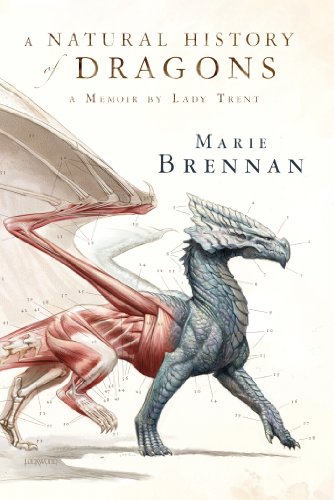
I’m not going to start at the beginning with A Natural History of Dragons, by Marie Brennan; I’m going to start before the beginning — at the cover. Why? Because it’s gorgeous: a beautifully drawn, silver and blue and grey hued dragon walking on all fours, its left front and right hind leg in the process of moving forward; its powerful legs, erect head, out-thrust chest, and soaring wings proclaiming its power; while the back half has been illustratively flayed to reveal its carefully numbered and delineated muscles, bones, and layers of underskin that create that power. It looks ripped right out of Gray’s Anatomy (the text, not the show). The interior illustrations, also by Todd Lockwood, are equally beautiful, losing little in their shift to simple black and white lines. I wish more fantasy novels had such artistic enhancements and here’s hoping this book encourages it.
Beyond its beauty, the cover is a good place to start because it stands as a good metaphor for this book, which in many ways is two stories rather than one. Unfortunately, the second story, which like the interior illustrations, lacks comparable color and vibrancy, and suffers more than the drawings for that loss.
The novel is presented (and subtitled) as A Memoir by Lady Trent, written in her later years as she looks back over her surprising career as a female scientist who has focused her life on dragons. The descriptors “Lady” and “female scientist” pretty much explain the “surprising” aspect of her career, as Isabella Trent is firmly ensconced in her formative years in a pseudo-Victorian era where women, especially upper-class women, spend their time learning music, gossiping, and trying to find a good husbandly match. They certainly do not spend their time learning science, they absolutely positively do not go out into the wilder parts of the world to try to add to science’s body of knowledge, and they certainly positively absolutely do not place themselves face to face with dragons.
Yet somehow, Isabella Trent fails to receive that message (not that it isn’t delivered to her many times) and so grows up to become perhaps the best known dragon naturalist. Brennan does a great job with Lady Trent’s voice from the very start. Here she is explaining the impetus for the memoir:
Not a day goes by that the post does not bring me at least one letter from a young person (or sometimes one not so young) who wishes to follow in my footsteps and become a dragon naturalist. Nowadays, of course, the field is quite respectable, with university courses and intellectual societies putting out fat volumes titled Proceedings of some meeting or other. Those interested in respectable things, however, attend my lectures. The ones who write to me invariably want to hear about my adventures: my escape from captivity in the swamps of Mouleen, or my role in the great Battle of Keonga, or (most frequently) my flight to the inhospitable heights of the Mrtyahaima peaks, the only place on earth where the secrets of dragonkind could be unlocked… I have therefore accepted the offer from Messrs. Carrigdon & Rudge to publish a series of memoirs… these shall focus on those expeditions which led to the discovery for which I have become so famous, but there shall also be occasional digressions into matters more entertaining, personal, or even (yes) salacious. One benefit of being an old woman now, and moreover one who has been called a ‘national treasure’ is that there are very few who can tell me what I may and may not write.
Brennan had me at the very start with this wry, rebellious, sardonic voice and kept me for a good long time as we meet her younger self, rebelling against the strictures of the time and culture which relegate her to music and husband-hunting when she’d rather be out pursuing knowledge and dragons. Luckily for her, though, not all the men around her ascribe fully to society’s mores and so with understanding and assistance from her father, her husband, and a peer of the realm, she’s soon off to the mountains on her first expedition, where she’ll face “frozen mountains… hostile foreigners, hostile fellow countrymen, bad decisions” and, of course, dragons.
So, props for the voice. And for the characterization, as we really get to feel the frustration and anguish of the younger Lady Trent as she becomes first captivated by dragons and science and then thwarted in her first attempts to make them part of her life. Brennan does a good job as well, if less detailed, with Isabella’s family and her husband to be, whom she meets at the king’s menagerie in a wonderful scene where she must navigate the treacherous balance between seeming “bookish” and being interesting. This first part of A Natural History of Dragons, about the first 100 pages, is therefore a sort of Jane Austen coming of age story, if Jane Austen lived in a world with dragons. And it’s my favorite part of the book for the above, as well as for its humor and its nice job of offering up some teasing flash-forwards to whet our interest.
Unfortunately, the last two-thirds aren’t as strong. The novel shifts from Jane Austen, and not toward a fantasy that I expected, but more toward a Victorian sort of Nancy Drew. Now, I confess to having had a great crush on Nancy Drew (I’m a sucker for “titian hair”), but still, this shift didn’t work for me. The pacing slowed greatly and while A Natural History still held my attention, it did so less completely. And while I still enjoyed Lady Trent’s voice, it felt a little less vivaciously spontaneous and more summative. Despite dangers and dragons and smugglers and hidden pits and ruins, etc., the novel felt like it lost a bit of its bright edge, which was a great disappointment as it had started out so strongly. I wanted more dragons, I wanted more of a sense of the world around them (the detail is pretty slim), I wanted more of the “pop” I’d experienced in Lady Trent’s rebellious youth.
By the end, therefore, the book felt like it hadn’t matched the potential and the promise of its first third and while I was interested enough to finish A Natural History of Dragons, it wasn’t with the same eagerness that I’d moved through the first hundred pages. It has a wholly endearing beginning, but its pacing throughout the latter parts and somewhat dry presentation of plot turned what had been a thoroughly enjoyable book into an only mildly entertaining one. Lady Trent tells us early on that this is just the first of her many adventures, and if that is true in its real-world existence as well, I’ll certainly give a second book about Lady Trent a look, based not on the bulk of A Natural History of Dragons, but in hopes it recaptures the novel’s early magic.
~Bill Capossere
 I thought that this was charming and imaginative, and I thoroughly enjoyed reading it. I liked the perspective provided by the conceit of an older woman writing about her younger self’s experiences, and the acknowledgement that how own behavior had been, at times, less than commendable or fair. I’m definitely looking forward to the next book, The Tropic of Serpents.
~Jana Nyman


Trackbacks/Pingbacks