
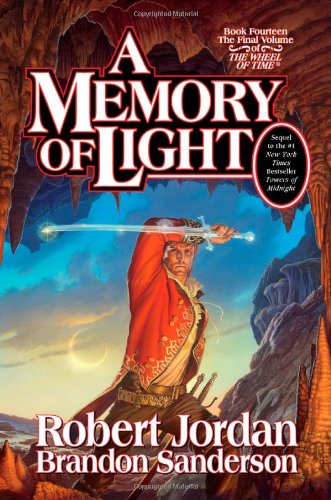
 A Memory of Light by Robert Jordan & Brandon Sanderson
Every now and then, I find myself writing a review that I know just really doesn’t matter. Usually, you like to think of your reviews as acting as a guide to potential readers as to whether or not they should give any particular book a shot. Somebody out there somewhere saw this book and is wondering, “Hmm, I’m not so sure about this one, should I try it?” or somebody out there never heard of this book and is thinking, “hmm, that sounds intriguing; off to my local independently owned small bookshop right around the corner!” (leave me my dream). But let’s face it, when you’re reviewing, as I am with A Memory of Light by Robert Jordan via Brandon Sanderson, the fourteenth and final book of a series (in this case, THE WHEEL OF TIME), there is no reader out there metaphorically tossing its hefty weight from hand to hand thinking, “Should I or shouldn’t I, should I or shouldn’t I?”
No, if you’ve read books 1-13, you ain’t stopping now based on some review. And if you haven’t read books 1-13, you ain’t reading this review. Which means basically I could write the equivalent of Charlie Brown’s teacher-speak here — “Wahwah woh wah wha wahwah” — and it wouldn’t matter one jot. Sigh. But, as they say, “The Wheel weaves as the Wheel wills,” so here we go…
First, if you like fights and battles, hoo boy will you like A Memory of Light. Because this 900-page book is basically one big, ongoing, relentless fight scene. And that’s a word — relentless — I’d use if forced to choose just one in describing it. The first 300 pages are somewhat setup as players on both sides arrange themselves in preparation for the final battle. But “setup” is relative in this book. We’re not six pages in before we’re tossed into the middle of a fierce city defense against rampaging Trollocs, a fight that we go back and forth between amongst other, less frantic plotlines. That battle ends around 75 pages later, and we get a little breather in perhaps the least action-based section of the novel (though still time for a rescue attempt and a magical fight), which lasts for about 100 pages before we’re thrown into another full-scale battle. From that point on, the next 700 or so pages are a series of geographically separated battles where our main characters are in separate groups, and then those battles eventually merge into one almost incomprehensibly huge battle where all are characters are in the same rough place: at the mouth of Shayol Ghul.
The separate battles are broken up by several long chase scenes/fights involving Perrin and Slayer and by Mat’s storyline whereby he becomes Tuon’s husband in more than simply title (as in she begins to place her trust in him) and then becomes the general of her army. The single epic battle — the “Last Battle” — takes up almost half the book. It is only broken up, and this only slightly, by Rand’s separate battle with the Dark One, a less physical, more metaphorical fight that takes place outside the actual fighting (indeed, outside the Pattern itself). I suppose one could also argue that the frantic, epic battle writ large is also broken up by a series of one-on-one sword duels that take place and by some small scenes here and there between individuals. But really, it pretty much is a non-stop, relentless, sweep-you-along-or-be-crushed fight scene.
How you will react to this is a matter of taste. To be honest, I would have preferred less fighting, as it began to feel a bit repetitive, especially the earlier battles and Perrin’s chase scenes. Once the Last Battle began, though, it was nigh impossible not to get swept along in its breakneck pace and epic scale, though again, there were a few segments I thought were a bit too repetitive and some individual scenes varied in their emotional impact or sense of tension. The same is true for the death scenes, of which there are many. And I mean many. Several pack a wallop, some hit you at least a little, and others were a bit perfunctory.
Surprisingly, and somewhat disappointingly, the storyline dealing with Rand and the Dark One in Shayol Ghul felt mostly anticlimactic and not all that original. I won’t say more to avoid spoilers, but while I do think we needed some variety of tone and pace (it couldn’t all be hacking and being hacked), these segments didn’t quite fill the bill for me. They felt a bit out of place, or if not out of place, not as seamlessly integrated as they needed to be. The same goes for a big chunk of Perrin’s storyline, which I felt suffered from being redundant and a bit monotone (save for one excellent and powerful scene at the very end). Mat’s section also had its recurring moments and themes, but overall I thought it was the most interesting long-term arc in the book, the one with the most plot variety and the most character growth. Lots of other characters get some great moments, some get more than one or two, a few are a bit robbed of their moment to shine, and a few get theirs a little cheaply (one, for instance, was tainted by a heaping spoonful of Deus Ex Machina).
All of which makes this a very fitting ending to this long-running series, one that I admit started to disappoint after the first four books or so. It’s hard to over-emphasize how much is packed into this one book; even at 900 pages it feels overstuffed. And I do think Sanderson has done an excellent job of streamlining (hard as that is to believe) and of improving pacing; he deserves a lot of credit for taking up a pretty thankless job: replacing a beloved author to close out a beloved series. But more isn’t always more. I enjoyed A Memory of Light, and as I said, was often swept up in it. Individually, each fight scene, each duel, each skirmish or battle or stands well on its own. But I would have probably skipped the four early battles, a duel here and there, and cut out a few hundred pages.
Just as I would have cut out a good number of books from the series as a whole. I absolutely loved the start of this series. And Jordan kept me going for a while, even after some of his tics grew tiresome or as the plot was less able to cover up some weakness of style or character. But by the middle of the series I began to feel like I was plodding forward relatively joylessly. And I hate to say it, but I don’t think I’d recommend it to anyone to start the series, since there is so much time to invest in it and I think the balance tips too far to the wrong side of readerly enjoyment. There is, I absolutely believe, an utterly great 5-6 book series buried in this 14-book narrative and I’d love to see almost an anti-Director’s Cut (a former-fan’s cut maybe) of that version. Or an HBO version (a la A Game of Thrones) that runs five seasons rather than fourteen. But while I wouldn’t tell someone to start the series, I have to say that A Memory of Light does a mostly good and certainly an appropriate job of ending it for those of us who have been there from the beginning.
So to sum up, Wahwah woh wah wha wahwah.
~Bill Capossere
If Robert Jordan lived in his own fantasy universe, I have to think he’d be the sort of fellow who would ask for the biggest damn sword he could heft. Not because it was practical, or even practicable at times, but because he thought it was just awesome that way. THE WHEEL OF TIME series is, at its core, Epic Fantasy carried to its furthest logical extreme. Isn’t that the only real point we can take away from this? Jordan, never content with one mythology or legend, decided to pour them all into a single body of work. His mission was to compile nearly every trope and plot element that Epic Fantasy had to offer, set the stage for the biggest conceivable struggle he could dream up, and then blow it all to kingdom come and drop the microphone on the whole subgenre. It’s meant, I think, as the Epic Fantasy to end all Epic Fantasy.
Is it derivative? Well, yes. Farmer-turns-hero-faces-Dark-Lord is only the tiniest fraction of the references shamelessly piled on here. The main characters directly symbolize Norse gods and Arthurian heroes (if anyone has been wondering where the name Nynaeve came from, for instance, it’s a by-name of the Lady of the Lake with an added vowel). There are kingdoms of samurai, kingdoms of Herbert’s Fremen, kingdoms of Machiavellian princes. There are Knights Templar, Nazgul, and super-powered nuns. Every magician is insanely overpowered, every other swordsman has a magic katana, and every woman is either startlingly good-looking or fascinatingly ugly. Furthermore, let’s not lie to ourselves on how well it all meshes together: none of this is particularly measured or considered. We have all different types of mythology and philosophy jumbled into the same vessel with little to no consideration for the original material. Look deeper than the surface level on all these references, and it becomes impossible to make sense of why they’re there at all. Gawain is Galahad’s half-brother, Arthur died centuries before, but his descendents are back in insectoid armor and fly around on quasi-dragons and…what?
Likewise, it’s pretty much impossible to figure out how Mat’s Odin and Perrin’s Perun are supposed to fit together in any way at all. We probably shouldn’t try: that way lies madness. So why are these elements here, doing a little jig and drawing attention to themselves? Well, frankly, just because. As far as I can tell, Jordan never built in these elements to say much of anything: he just dumped everything he could lay his hands on into the cauldron and stirred, probably cackling maniacally all the while. If he had any justification for it, it was probably that “these were the templates on which our myths were formed, hee hee. Now let’s make the samurai fight the Knights Templar.” Anyway, let’s call this stage set. That’s the Wheel of Time. It’s big, it’s bombastic, it’s cheesy, it’s kind of dumb, and even at its low points (which have been admittedly very low indeed) it’s at least slightly entertaining to witness.
Given all of this, it’s perhaps unsurprising that the last book in the series is not just a finale, but a cataclysm. For a fourteen book epic leading up to “the Last Battle”, we need a volume that makes all the waiting seem worthwhile. So A Memory of Light is just that: one enormously elongated battle sequence. I think the concept is sound in relation to the rest of the series, but it does make the book something of a chore. The issue, I think, is that all the maneuvering is done, and we’ve long since witnessed how all of these tropes play off each other, meaning that all we have left to us is the inevitable wrap-up which — by necessity, given all the epics it’s drawing on — is pretty much mapped out from the get-go. Coming into this novel, nobody really thinks that any of these characters is going to surprise us. Mat’s going to become commander of the forces of the Light at some point. Perrin will summon the wolves at an appropriately dramatic moment. Rand will march his predestined posterior right into Shayol Ghul and do precisely what we all know he has to, given that — as we’ve been unceasingly reminded — time is a wheel and the Age of Legends occurred and will occur again with a certain status quo in place. To put it more briefly, the suspense is dealt a blow before one even cracks the front cover, because the final book of THE WHEEL OF TIME is more the completion of a monument than a novel.
If there’s anyone writing epic fantasy just now with the skill to combat problems with suspense, it’s probably Brandon Sanderson. He knows most of the tricks for keeping the reader going, and given the format of his challenge — a thousand-page battle — he’s forced to pull out all the stops. The book is an endless string of sudden revelations and double blinds on dozens of fronts, as Sanderson performs death-defying feats of authorial acrobatics in a bold bid to distract us from the essential predictability of it all. He almost manages it, but in the end his plans are foiled by two factors: first, the characterization doesn’t work as it should; second, this book is just too damn long.
The latter isn’t strictly Sanderson’s fault, I think. A Memory of Light is Jordan’s baby, after all, and in typical overblown Jordan style, every single character has to have a Crowning Moment of Awesome (or two, or five…all except for poor Gawyn, who ends up looking completely ineffectual after two other characters, in succession, steal his Crowning Moment of Awesome and do it better). Given that the Wheel of Time often seems to have more point-of-view characters than the Library of Congress has books, working through a heroic climax for each one takes a while, and even after the arduous process is done the fireworks display just has to keep on going and going so that the dangling plot threads can be hastily knotted up. As I suggested above, I don’t think Sanderson had any say in how grandiose and outsized the finale was plotted to be, and I applaud some fairly Herculean efforts to make it all work. The trouble is that by any reasonable measure, this is excessive. A novel-length battle doesn’t have much in the way of pacing, and after about the midpoint of the book, I lost the epic tone completely and descended into cynicism, skipping to the ends of chapters to check if the character in question actually died this time before irritably going back and reading the whole thing. Yes, this novel turned me in the fantasy reader version of Ebenezer Scrooge. “If they’re going to die, they had better do it, and decrease the novel’s surplus population!” I grumped.
The other problem, as I mentioned above, is the characterization. This I do have to lay at Sanderson’s door. To my mind, his excellent world-building and plotting has often come at the cost of having little energy left for rounding out his characters. While I think he’s improved over the last few years, the punishing ordeal of juggling this many emotionally charged characters over such a long stretch of text seemed to overtax his patience. The characters walk the walk and talk the talk of the epic finale, but there’s little in the way of the small sparks of humanity that would have made their struggles poignant. The characters do what they do because that’s the way they’ve been developed over the course of the series, but they don’t have that many personal revelations or moments of depth. There are a few exceptions — notably the well-managed relationship of two fairly minor characters, Pevara and Androl — but on the whole the interactions and even the heroic sacrifices feel a little flat and typical. The battles are suspenseful and action-packed, but the characters who make them up feel a bit like plastic Army Men: the good guys are good and the bad guys are bad and they all hustle around doing their damnedest for the glory of Team Good or Team Bad. There’s a brief, rather surprising moment or two where it looks as though a villain might just be coaxed over to truth, justice, and the Andoran way; and so when said villain inevitably announces that a-HA, it was all an eeeeevil ploy, the plot twist arrives with all the drama of a sad little raspberry being blown in the distance.
Now, of course, I’m being especially hard on the novel because the weight of expectations was so ponderous, but I also want to make clear that the book could have been a lot worse. It’s exciting for most of the run, at least, even if the perpetual battle does get a little wearisome after a while. All the characters you’ve enjoyed over the course of the Wheel of Time are still recognizably themselves, strutting their stuff with decent aplomb. There aren’t a lot of major plot holes or inconsistencies, and while the wrap-up does feel a bit too simple and sudden, it more or less works. The word I think I must use for this finale is “solid.” It’s a good effort. It’s not great or legendary, but it drags this ridiculously outsized circus of a series to a fairly respectable finale. That’s no mean feat.
Could we have wished that Jordan’s grand ambitions had been met with equally grand realization? Of course, but in fairness the success of those grand ambitions began to falter some seven or eight books ago. The series has a decidedly checkered past. For some readers, A Memory of Light will be about as much as they could have hoped for as a good, if somewhat workmanlike finale. Others, perhaps looking for justification or validation after sticking with this series through thick and thin, may find the closing act a bit of a let-down. In the end, everyone has to decide for him or herself whether the final pay-off was worth the long and often somewhat grueling route to reach it. Still, I don’t think anyone can reasonably deny the charming audacity of Robert Jordan in dreaming something like this up, or of Brandon Sanderson in carrying off the climax. THE WHEEL OF TIME was a big, glorious, sensational mess of an idea that perhaps could only have worked in this genre, and its authors actually managed to pull it off with some credibility. That’s worth some applause.
~Tim Scheidler
The Wheel of Time turns, and Ages come and pass. What was, what will be, and what is, may yet fall under the Shadow. Let the Dragon ride again on the winds of time.


To be honest, I deserted this series quite early on after the promise of a fantastic first book was lost in a narrative bog. So there is an audience out there — of people who want to know whether they made a BIG mistake. Or (as it would seem) not. Thanks for easing my mind on that point, Bill!
First of all, I want to applaud Sanderson’s work ethic on this book. As I understand it, he wrote from Jordan’s outline and notes, and rewrote it several times. That is admirable. It’s probably not something I would do.
I appreciate your review, but can you, or someone, please tell me, then, why these are considered good? I don’t just meant the last one. I read THE WHEEL OF TIME and thought it was all right; I put down the second book very early (I remember nothing of it except its tedium and lack of characterization) and I’ve never understood the appeal.
A couple of decades ago, two movie reviewers (Siskel and Ebert) reviewed the terrible DUNE movie that Dino de Laurentis (sp?) made. Roger Ebert said, “Maybe this will be a guilty pleasure, I mean, look at those sets! Look at the scale of the thing!” or words to that effect. Is it the same thing here? I just don’t get it.
Marion, I tried the first book and couldn’t get much farther than the middle. It just seemed too derivative of other authors and works that had come before–and not in a “knowing nod and a wink” kind of way, either.
On the other hand, I’ll gleefully admit to loving the sheer cheesiness and ridiculous ambition of the Dino De Laurentiis/David Lynch adaptation of DUNE. It’s like watching a fever dream.
“Good”? Uh, whoa, let’s not go that far. Audacious? Yeah. Entertaining? Possibly. Good? Neehhh… not really. I mean, Sanderson manages to do a pretty good job with *this* novel, but that’s not true of all of them.
Yeah, I guess the Ebert thing applies. At its best, WoT is attractive because there’s so MUCH imagination on display, and it’s all so grand. Take the dream world. It’s great. Very imaginative. It’s immense in scale, thought out to extremes, and it even feels archetypal in that odd way a great fantasy concept can strike home, as if it was something you’d known all along but only just remembered. For a moment, you’d think “yes, this works. This is good.”
Then, of course, Jordan would get back to the spankings and ruminations on embroidery.
I’ve no idea. Maybe it is because I started it way back when, young and idealistic, or because I just truly loved those characters when I first met them, and I had to follow through and find out what happened to them all.
I just enjoyed the heck out of them and kept re-reading them as new ones came out – up until the last three. Those I’ve only read the once and I haven’t gone back to the series since.
April, you may have hit on it. If the first book or books spoke to you or moved you in some way, then that would do it. I love some books I know objectively aren’t very well written, because I read them at a certain point in my life and they connected in some way. I think Jordan’s series must be that kind of thing.
Yes, what April said. Most of us read them years ago when we were younger and more idealistic and they were new. We got attached to the characters. I will say, though, that I have given up on the series twice. I stopped in the middle somewhere the first time because they just started to drag and I got mad. (Crossroads of Twilight is one of the worst fantasy novels ever sold by Tor, in my opinion.) After starting this website, I wanted to re-read them so we’d have them all reviewed. I made it through book 12 which was the latest book at the time. Since Bill offered to review the last two books when they came out, I never did read them even, though I own the audio versions.
Solid probably a fitting epitaph for a conclusory volume to an epic this size. Endings are hard, especially when they have to struggle under the weight of all the buildup. (Look at Neal Stephenson, who has never ever written a decent ending to any novel, but is still very enjoyable to read.) I thought Sanderson did an amazing job matching Jordan’s tone and herding all of the plot to a conclusion. And Jordan’s characterization is also pretty miraculous. He has a huge cast here and managed to be an effective ventriloquist throughout. His characters all have very distinct personalities with consistent motivations. And he evolved in good ways over the course of the series with his depictions of women and the relationships between men and women. (Sanderson even threw in a gay character or two.)
I mean WoT is the most genre of genre fantasies. It probably epitomizes what people don’t like about the genre: the pomposity, prone to cliche, magic as a deus ex machina, battles for their own sake, etc. But, almost for that reason, the series remains for me a warm blanket, a bowl of mac-n-cheese, a warm midsummer evening on a park bench. It’s familiar and comforting and I’m quite fond of it.
Note: to those above who started with book 1 and put it down, I’ll submit that book 1 is the worst written of the series. I did a complete re-read when AMoL came out, after not touching the series for 15 years, and almost gave up on it after book 1. It gets better. I even enjoyed the much-derided books 8-10. I should mention that I listened to the whole thing on audiobook over the course of about a year. Michael Kramer and Kate Redding share the narration for the entire 15 book series (counting the prequel) and they are marvelous.
Anathem and Reamde both have great endings. This critique is better applied to Stephenson’s earlier novels.
I guess that Bill found the core of the matter with this statement in his review of AMOL:
“There is, I absolutely believe, an utterly great 5-6 book series buried in this 14-book narrative and I’d love to see almost an anti-Director’s Cut (a former-fan’s cut maybe) of that version.”
There is brilliance in the Wheel of Time. And Jordan did have the gift to make the reader invest a lot of emotions in his characters and he could work with that. But all these things are buried under thousands of pages that are just “good”, “mediocre” or plain boring, but the great moments are there.